
Stepping outside your comfort zone: Tom’s advice on health and safety career excellence
Case Study: Tom Evans
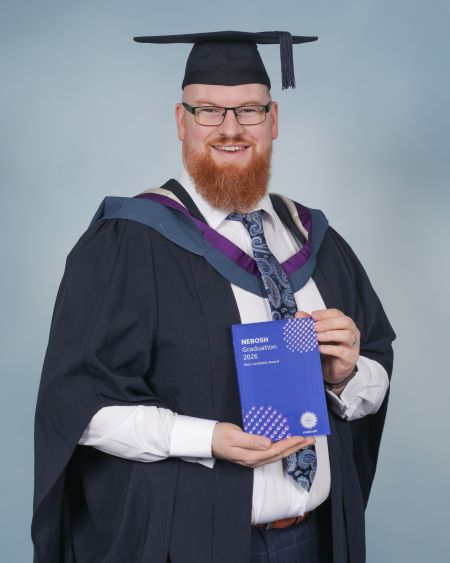
From starting out as a SHEQ Administrator at the age of 22 to becoming a EHS Specialist at Cargill, and completing the BSc (Hons) Health, Safety and Environmental Management (in partnership with NEBOSH) at the University of Hull along the way, Tom Evans knows what it takes to make a successful health and safety career. In this case study, NEBOSH National Diploma in Environmental Management Best Candidate Tom shares his journey and the challenges he sees the industry facing in the future.
What first drew you to a career in health and safety, and when did you realise it was the right career for you?
Like many health and safety professionals I've met throughout my career, I very much fell into health and safety by accident. I joined the SHEQ department as an administrator and, before long, found myself drawn into the work and wanting to learn more. I've always enjoyed helping people, and EHS gave me the opportunity to do that every day. I realised I could have a genuine positive impact, both directly by supporting colleagues and indirectly by working on projects that improve workplace safety, health or environmental performance. That's when I knew it was the right career for me.
You’ve completed the NEBOSH National General Certificate as well as the Level 6 National Diploma for Occupational Health and Safety Management Professionals. However, it was for the NEBOSH National Diploma in Environmental Management that you were named a Best Candidate. Congratulations!
A) What made you choose to study the Environmental Management Diploma?
Although the Environmental Management Diploma formed part of my degree programme at the University of Hull, it wasn't something I viewed as simply another qualification to complete. It was something I was genuinely interested in studying. I've always had an interest in environmental issues, sustainability and green energy, so the Diploma was an opportunity to develop my knowledge in an area I was passionate about. I've also never wanted to specialise in just one area and have always seen myself as a broader EHS professional. Organisations increasingly need people who can understand both disciplines and the way they interact. Developing my environmental knowledge alongside my health and safety expertise felt like a natural progression and has helped me become a more rounded practitioner.
B) How has achieving the Diploma helped you so far?
Achieving the Diploma has built on the environmental knowledge and experience I had already developed throughout my career and has given me greater confidence in this area. It’s also given me the opportunity to explore a subject I’m passionate about in much greater depth. The qualification has strengthened my ability to discuss environmental matters with stakeholders and helped me think more strategically about environmental risks, compliance and performance. Most importantly, it has strengthened my ability to ensure environmental considerations are given equal weight alongside health and safety when supporting business decisions.
Being named a NEBOSH Best Candidate was also a huge personal achievement. As someone who is neurodiverse, academic study has never come naturally to me, and I've had to work incredibly hard throughout my education and professional development. To receive that recognition was a real validation of the effort, perseverance and study techniques I've developed over the years. It's something I'm extremely proud of and has given me even more motivation to continue learning, developing and challenging myself professionally.
What is the best thing you’ve learned through your NEBOSH studies?
For all the procedures, policies and instructions that organisations put in place, lasting improvements come from creating a culture where people genuinely care about doing the right thing.
You’re currently an Environment, Health & Safety Specialist at Cargill. Can you tell us a little about the company and what your role entails?
Cargill is one of the world's largest food and agriculture companies, operating in more than 70 countries and working every day to nourish the world in a safe, responsible and sustainable way. The company connects farmers, producers, manufacturers and customers across global food, agriculture, industrial and financial supply chains, helping provide food, ingredients and essential products to millions of people around the world. I work within Cargill's specialised portfolio, where we manufacture additives that are used in everyday products, from the plastic bottles we drink from to the clothes we wear.
As an Environment, Health & Safety Specialist, my role is to help ensure our site operates safely, sustainably and in compliance with regulatory requirements. It's an incredibly varied role that involves everything from incident investigation and risk management to environmental compliance, auditing, emergency preparedness and supporting major projects. I have the opportunity to work with people across all levels of the organisation, helping solve problems, improve our EHS systems and drive positive change across the site.
What would you say is the most rewarding thing about your job?
For me, it’s seeing the progress from an identified need to a successful outcome. There's a real sense of achievement in identifying a gap, developing a solution and implementing changes that make a meaningful difference to the business. I particularly enjoy finding ways to simplify complex processes and using technology to reduce the administrative burden that can often be associated with EHS activities. Reducing this burden helps people focus on managing risks rather than completing paperwork. Ultimately, it's about more than procedures or compliance; it's about influencing the way people think about EHS and knowing you've helped create a safer and more sustainable workplace.
Looking back on your career to date, what achievement are you most proud of?
I'm most proud of the journey I've been on; I started as a fresh-faced 22-year-old administrator without a clear plan for where I wanted to end up, and today I have a career I'm genuinely passionate about. While I'm proud of the qualifications I've achieved along the way, the experience that has really shaped me has come from the day-to-day realities of the job: managing incidents, working through difficult challenges and sometimes being thrown in at the deep end. Those experiences have helped me grow both professionally and personally, and I'm proud of the person they've helped me become.
Can you tell us about your ambitions for the future?
I want to continue growing both professionally and personally, building on the experience I've gained so far while taking on greater leadership responsibilities. Over time, I'd like to transition into senior EHS leadership roles where I can help shape strategy, challenge traditional ways of thinking and influence how organisations approach health and safety.
I'm particularly interested in finding new and innovative ways of working. Too often, health and safety can become bogged down in processes and administration. I'm passionate about using technology and fresh thinking to make health and safety more effective, more efficient and more focused on managing real risks. Ultimately, I want to help drive meaningful change, not just within a single organisation, but in how the profession thinks about and delivers health and safety in the future.
What do you see as the biggest challenge facing health and safety professionals today?
I think one of the biggest challenges facing health and safety professionals today is the rise of artificial intelligence. There's no doubt that AI can be an incredibly useful tool for streamlining tasks, improving efficiency and helping professionals develop and refine ideas. However, I also see a risk that it becomes a substitute for genuine knowledge and experience, allowing people to present themselves as more competent than they really are. The job of a health and safety professional is ultimately about understanding risk, making sound judgements and applying experience. These are things that cannot be generated by a prompt.
I also have concerns about the sheer volume of AI-generated content entering the profession. While posters, presentations and communications have their place, there's a risk of overwhelming people with information to the point where important messages lose their impact. In the same way that people can become blind to safety signs, I think we need to be careful that we don't create a future where workers are bombarded with so much generic health and safety content that they simply stop engaging with it. The challenge for health and safety professionals will be finding the right balance: embracing the benefits of AI while ensuring we continue to value expertise, critical thinking and meaningful engagement.
What would your advice be to anyone at the start of their health and safety career?
Put the work in, stay curious and don't take shortcuts. Qualifications are important, but the biggest leaps in your knowledge, confidence and development will often come from experience. Some of the most valuable learning opportunities can be uncomfortable, whether that's being involved in a major incident, managing a difficult situation or being thrown in at the deep end. Those experiences test you, but they're also the moments where you grow the most. Embrace every opportunity to learn, because the lessons you gain through real-world experience are often the ones that stay with you for the rest of your career.