
Learning, serving and protecting people: Abdulazeez Oluwatosin Akinboro’s journey in health and safety
Case Study: Abdulazeez Oluwatosin Akinboro
For this HSE Supervisor, health and safety is about far more than audits, procedures, and compliance. It is about people. From taking his first health and safety training courses in Nigeria to taking on increasing responsibility within one of West Africa's largest manufacturing organisations, Abdulazeez Oluwatosin Akinboro’s career has been guided by a simple belief. Every worker deserves to return home safely at the end of the day. In this interview, we discuss his career journey, the impact of his NEBOSH studies, and his vision for the future of the profession.
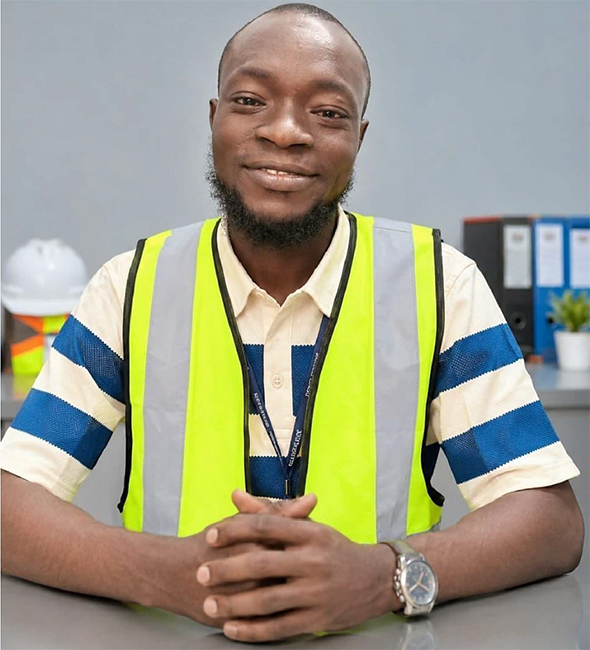
What made you decide to pursue a career in health and safety, and how did you make it happen?
I first encountered health and safety while studying for my National Diploma in Nigeria. One course introduced me to workplace health and safety, and although I did not plan for it to become my career at the time, the subject stayed with me.
After completing my National Diploma, I came across an opportunity to undertake health and safety training, including firefighting and fire prevention, first aid, and cardiopulmonary resuscitation (CPR). I was the only person who took up the opportunity. Completing those courses gave me my second major exposure to occupational health and safety, and I began to see it as a career I could pursue.
However, I soon realised that courses alone would not be enough. I needed practical experience.
In the first HSE role I secured, I found that some of the basic safety arrangements were not yet in place. As a novice, I did not feel equipped to address everything on my own, but I did my best using the knowledge I had gained from my introductory training. That experience taught me an important lesson very early in my career: if I wanted to become competent, I needed to place myself in an environment where I could learn from experienced safety professionals.
I therefore secured a contractor role within a major manufacturing organisation that provided exactly this learning environment. The financial reward at the beginning was modest, but I saw it as an opportunity to invest in myself. I wanted to develop the right safety mindset by working alongside experienced professionals, so I deliberately chose learning over immediate financial comfort.
Working alongside my mentors gave me many opportunities to learn. Seeing how they approached different situations accelerated my development and reinforced my desire to pursue a long-term career in the profession. This experience also inspired me to pursue the NEBOSH International General Certificate in Occupational Health and Safety.
Looking back, my journey was not a straight line. It was a series of decisions that kept me learning, adapting, and deliberately creating opportunities for myself to grow.
You have completed the NEBOSH International General Certificate in Occupational Health and Safety, studying with NEBOSH Gold Learning Partner Hybrid-HSE Limited. Why did you pick this qualification and how has it helped you?
People's lives can be affected by the decisions I make, so I wanted more than practical experience alone. I chose to pursue the NEBOSH International General Certificate to gain a structured understanding of occupational health and safety and ensure my decisions were based on sound principles.
Taking the course was a financial challenge, but I made a conscious decision to invest in my professional development. I chose to study with Hybrid-HSE Limited because they offered the structure and guidance I needed to achieve the qualification.
The qualification strengthened my understanding of hazards, risk assessment, the hierarchy of controls, and occupational safety management more broadly. It also gave me greater confidence when engaging with workers and management, whether challenging unsafe conditions or making safety recommendations.
The most valuable thing I learned was that effective safety management is systematic. It is not enough to identify that something is hazardous. We need to understand who may be exposed, how they may be harmed, how significant the risk is, what controls are already in place, and whether those controls are effective.
I also learned that safety is about much more than paperwork. Behind every risk assessment, inspection, procedure, and control is a person who deserves to go home safely. That perspective has stayed with me throughout my career.
Achieving the NEBOSH International General Certificate in Occupational Health and Safety was a significant turning point in my career because it strengthened the connection between what I was learning in the classroom and what I was experiencing in the workplace.
Since entering the profession four years ago, you have worked in a range of industries. How easy have you found it to transition between sectors, and do you have any tips you can share?
Throughout my career, I have moved between construction, manufacturing, food production, and industrial processing, which has been both challenging and a major accelerator of my professional growth. Every industry has its own processes, hazards, risk profile, and working culture, but I have found that the fundamental principles of health and safety remain consistent. It therefore makes sense to focus on those fundamentals first rather than trying to understand every technical detail immediately.
Hazard identification, risk assessment, the hierarchy of controls, safe systems of work, and worker engagement remain relevant regardless of the industry, and my NEBOSH studies gave me a strong foundation in these principles. Having the opportunity to gain practical experience in different environments has reinforced that learning.
I have found that one of the fastest ways to understand a new workplace is to listen to the people who work there every day. Through inspections, Gemba walks, and conversations with workers and supervisors, I can learn how processes actually operate, identify concerns, and uncover risks that may not be obvious from procedures or documentation.
Perhaps most importantly, I have learned to leave the "Mr Know-It-All" attitude at the door. Even when you have qualifications or previous experience, you should not enter a new workplace assuming you know more than the people already working there. Someone operating a machine or working within a particular process may have years of practical knowledge about that environment. I respect that experience and learn from it.
My advice to anyone moving between sectors is simple: master the fundamentals, ask questions, listen to frontline workers, remain curious, and be prepared to learn, unlearn, and relearn. You do not have to know everything on your first day. What matters is having the humility and willingness to keep learning.
You have worked for Flour Mills of Nigeria (FMN) since September 2025. Can you tell us a little about the company and what you have learnt about health and safety since joining the company?
Flour Mills of Nigeria (FMN) is one of the largest industrial conglomerates in Nigeria and a leading agro-allied business in West Africa. FMN is an industry leader in the production of flour, semolina, pasta, noodles, snacks, vegetable oils, and spreads, all supported by its packaging, port operations, transport, and logistics businesses.
Since joining the organisation, I have worked in one of its large manufacturing plants, where I have gained a valuable appreciation of how health and safety systems operate at scale and the importance of shared ownership. Safety cannot belong to the HSE department alone. Production, engineering, technical teams, warehouse personnel, contractors, supervisors, and management all influence safety outcomes through the decisions they make every day.
I have also gained greater exposure to structured process safety, data collection, reporting, performance monitoring, and the use of information to identify areas for improvement.
This has all reinforced an important lesson for me: a safety management system is only effective when it reaches the workplace. A policy can be well written. A procedure can be comprehensive. A risk assessment can be technically sound. But the real test is what happens when the work begins. As an HSE professional, my responsibility is not simply to understand the system, but to help translate it into practical controls that make sense to the workforce and are effective in the operational environment.
As a Health, Safety and Environment Supervisor, my primary focus is translating HSE systems and risk management requirements into practical controls that work in day-to-day operations.
My role is very hands-on. I monitor compliance, identify hazards, engage with workers and supervisors, and follow up to ensure that safety requirements are not only documented but also implemented in practice.
My key responsibilities include conducting workplace inspections, Gemba walks, and hazard identification activities across operational areas; monitoring compliance with established HSE requirements and safe working procedures; delivering safety inductions and toolbox talks; engaging with employees and contractors; maintaining HSE records and reports; and supporting emergency preparedness activities.
I also work closely with operational teams to understand the risks associated with their activities and ensure that appropriate controls are in place. One of the most important aspects of the role is being close to the work itself. There can sometimes be a difference between what a procedure says should happen and what happens in practice. Being present in the workplace allows me to identify those gaps and work with the people involved to close them.
Ultimately, I see my role as supporting the operation while helping to ensure that people are protected from harm. It is not simply about enforcing rules. It is about helping people understand the risks associated with their work, why the controls matter, and how we can make safe working the normal way of working.
What do you enjoy most about being part of the health and safety profession?
I would say it is the opportunity to make a meaningful difference in people's lives. At its core, this profession deals directly with human life. That gives the work a purpose that goes beyond policies, procedures, and compliance.
For me personally, being a health and safety professional also brings a deep sense of fulfilment because it gives me an opportunity to serve my Creator through serving others.
Every worker has people waiting for them at home. When I identify a hazard, improve a control, have a safety conversation with a worker, or challenge an unsafe condition, I know that my actions could contribute to that person returning safely to their family at the end of the day. That is deeply fulfilling.
I also enjoy the dynamic nature of the profession. Every day presents a different challenge. Sometimes it is understanding a process; sometimes it is solving a safety problem; and sometimes it is helping someone recognise a risk they had previously overlooked.
One of the most rewarding moments is when workers begin taking ownership of safety themselves, when someone raises a concern, identifies a hazard, or reminds a colleague about a safe way of working without waiting for the HSE team. That tells me that safety is becoming part of the culture.
Ultimately, what keeps me passionate about this profession is knowing that my work can contribute in a practical way to protecting people and helping them return safely to the families and communities that depend on them.
What achievement are you most proud of in your career?
I am proud of the rapid growth and development I have experienced since entering the health and safety profession. In a relatively short period, I have gained the field experience, knowledge, and professional confidence that have allowed me to take on increasing levels of responsibility.
One particularly meaningful moment occurred after my site underwent an unannounced internal safety audit. The auditor had never met me before, but after spending two days assessing the site, I received feedback that my contribution and approach had been positively recognised. A recommendation was also made that I should remain at the site so that I could continue contributing to its safety improvement.
That recommendation was significant to me because it showed that the work I was doing on the ground was being recognised, independently of my own self-assessment.
A few months later, I was put forward for a more senior safety position. I went through a selection process with other candidates and was ultimately offered the role. This has been one of the most encouraging moments of my career because it showed me that professional growth is not just about how long you have been in the field. It is also about the value you bring, the trust you build, your willingness to learn, and the consistency with which you do your work.
For me, the achievement is therefore bigger than a change in job title. It is the recognition that continuous learning, practical experience, humility, and commitment to the work can create opportunities for greater responsibility.
What do you consider to be the biggest challenge facing health and safety professionals today?
From my experience working in a developing-country context, I believe one of the biggest challenges is turning safety expectations into consistent practice. A safety management system can be comprehensive on paper, but its effectiveness ultimately depends on implementation.
Two things are particularly important in my opinion:
- Visible leadership commitment: People naturally observe what leaders do as well as what leaders say. When safety expectations are applied consistently across an organisation, regardless of position or seniority, it reinforces the message that safety standards are there to protect everyone. Effective safety leadership therefore requires accountability, consistency, and openness.
- Empowering safety professionals to speak up: Safety professionals need to be able to identify, challenge, and escalate risks appropriately without fear of retaliation. There will always be difficult conversations in health and safety, because our responsibility sometimes requires us to question how work is being carried out. Organisations can strengthen their safety culture by creating an environment where raising a concern is seen as a positive contribution to improvement.
For me, the goal is not confrontation. It is creating a professional environment where everyone, regardless of position, can contribute to identifying risks and improving safety.
How do you think the profession will evolve over the next few years, and what opportunities and challenges will this create?
I believe the health and safety profession is entering an important period of transformation. Over the next few years, I expect the perception of the profession to shift from being seen primarily as a compliance function to being recognised as a strategic business partner that makes a vital contribution to organisational performance, resilience, and sustainability.
Globally, I see technology and data becoming increasingly important. Digital reporting systems, real-time monitoring, sensors, automation, and data analytics will give safety professionals greater visibility into what is happening in workplaces. Technology will not replace the safety professional. Instead, it can support better decision-making by helping to identify trends and enable earlier intervention before incidents occur.
I also expect the profession to broaden. Physical safety will remain fundamental, but greater attention will be given to occupational health, ergonomics, fatigue, psychosocial risks, wellbeing, and the wider relationship between work and human health.
In Nigeria specifically, I see opportunities arising from the increasing legislative attention being given to occupational safety and health. The National Assembly has considered proposals aimed at strengthening the country's occupational safety and health framework. If these developments result in a stronger and more comprehensive national framework, they could create greater opportunities for professionalisation, clearer responsibilities, and stronger organisational accountability. However, legislation alone will not transform workplace safety. Nigeria has a diverse economy, including a large informal sector, and there will continue to be challenges in translating standards and legal requirements into consistent workplace practice.
I also believe health and safety will become increasingly connected to Environmental, Social and Governance (ESG) priorities and sustainability. Worker safety, occupational health, and decent working conditions are fundamental elements of responsible business.
Ultimately, I believe the most effective safety professionals of the future will be those who combine sound technical knowledge with the effective use of technology, data interpretation, and genuine human leadership. Even with technological and legislative change, health and safety professionals will still be responsible for understanding risk, influencing decisions, and ensuring that controls work effectively.
The profession will evolve, but its purpose will remain the same: protecting people and helping them return safely to the people waiting for them at home.
What advice would you give to someone who would like to work in health and safety?
I would advise anyone who wishes to work in health and safety to:
- Start with the right mindset: Understand that you are taking on a responsibility that involves human lives. Every worker who leaves home to go to work carries an expectation from the people who love them that they will return home safely. As health and safety professionals, we have a responsibility to help make that expectation a reality.
- Seek knowledge continuously: Do not assume that a qualification or certificate alone makes you competent. Every workplace, process, and risk presents an opportunity to learn something new. When human life is involved, we must take competence seriously.
- Hold yourself accountable: At the end of each month, when you receive your salary, ask yourself: Did I genuinely do my due diligence? Did I speak up when I saw something unsafe? Did I follow up on the risks I identified? Our responsibility is much greater than completing an inspection or submitting a report. We should be able to look back at our work and know that we made a genuine effort to protect people.
- Develop the courage to stand up for what is right: You will sometimes face resistance, pushback, or uncomfortable conversations when you challenge unsafe practices. Do not allow fear of retaliation or humiliation to stop you from carrying out your professional duty. At the same time, enforcement should be carried out with respect, fairness, and good judgement.
- Understand that our role is not to stop organisations from operating: Every organisation has risks because every organisation has processes that enable it to function. Our responsibility is to help ensure that those processes are carried out safely. We must help ensure that workers, contractors, and visitors can enter a workplace safely and leave it safely, without harm.
Ultimately, the greatest measure of our work is not how many forms we completed or how many inspections we conducted. It is the number of people who were able to finish their working day and return safely to the people waiting for them at home.