
From social care to safety excellence: Iyla’s journey to NEBOSH best candidate success
Case Study: Iyla Ahmed
From a planned career in law to becoming an award-winning social care leader, Iyla has built a career focused on improving lives through quality care and strong safety leadership. In this case study, she shares how the NEBOSH Level 6 National Diploma strengthened her expertise, what it means to her to be named Best Candidate for Unit DN3, and her ambitions for the future of social care.
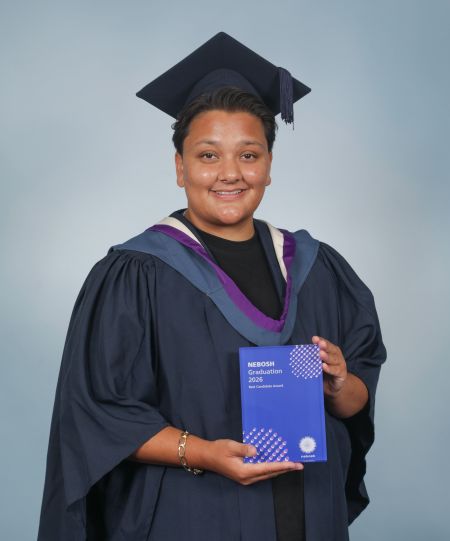
You recently completed the NEBOSH Level 6 National Diploma for Occupational Health and Safety Management Professionals, which you studied with NEBOSH Gold Learning Partner Phoenix Health & Safety. What first inspired you to pursue this qualification?
Alongside my work in social care, I developed a real passion for health and safety — I could see how much strong health and safety leadership matters in protecting both the people we support and the staff caring for them. I wanted my approach to be backed by more than instinct and experience, so I undertook my NEBOSH studies to root it in recognised best practice and a genuine understanding of risk management.
You have been named a Best Candidate for Unit DN3 for this qualification – Congratulations! What has this achievement meant to you?
It’s a genuinely proud moment. It’s not just a personal achievement — it’s another milestone in my commitment to raising standards across the sector, and a reminder that the work I put in outside of my day-to-day care responsibilities is paying off.
What is the most valuable thing you learned through your NEBOSH studies?
Effective risk management in care isn’t about eliminating risk altogether — it’s about balancing safety with the individual’s needs, independence, and quality of life. In complex care environments, getting that balance right is everything.
You are an award-winning care consultant and social care expert – what inspired you to first enter this sector?
I didn't set out to work in social care – I was actually studying for the bar and was on track for a legal career, with the goal of helping the most vulnerable in society. I ended up working for my mum during university, who'd been in the care sector for years, and that changed everything. I saw first hand what good care looks like and what happens when it's missing, and I couldn't walk away from that.
There's also a family history behind it. My grandma's sister, Barbara, had learning disabilities and autism and was non-verbal. When my grandma was young, Barbara was taken away and put into an institution. That experience shaped our family – it's what drove my mum into social care in the first place. Knowing that history, I wanted to carry it forward too.
You are also the Director of M&D Bespoke Properties Ltd. Please can you tell us about the company and its mission?
M&D Bespoke Properties works alongside my care business — we buy and source properties which are suited to becoming care homes, transform them, and put them to work for those who need them most. It means I can shape a home from the ground up with the people who’ll live there in mind, not just adapt whatever’s available.
Looking back on your career to date, what achievement are you most proud of?
Receiving this NEBOSH award is right up there — it represents a real milestone in my professional development and my commitment to raising standards across social care. But I’m also proud of what I’ve built through Wrap Around You: supporting children and adults with learning disabilities, autism, mental health needs and complex behaviours, and doing it in a way that puts quality of life at the centre.
What is next for your professional development?
Right now, most of my time is going into opening new homes — that’s the immediate focus. But I’ll also be heading back to university shortly to study for a Master’s in Mental Health Law, which will let me bring an even deeper level of expertise to how I support the people we work with.
How do you see social care evolving in the future, and what positive change would you most like to see in the sector?
Right now, over 2,000 people with learning disabilities, autism, or mental health conditions are stuck in mental health units when they should be in specialist homes. That’s the change I want to see — proper investment in specialist provision so people are supported in the right environment, not just the available one.
What advice would you give to other young people who want to make a difference through their work?
Take your time. It’s easy to feel rushed into things, but sit back and figure out what you want to do first. Once you know, indulge in it fully — become fixated on becoming the best version of that thing. That’s where success comes from.