
From forest floors to boardrooms: Jessie Bourke's people-first approach to health and safety
Case Study: Jessie Bourke
Jessie Bourke never planned on a career in health and safety. Today, as Health, Safety and Environmental Manager at Nati Growth, she supports a diverse range of businesses across forestry, farming, fisheries, beekeeping and property development on the East Coast of New Zealand's North Island. An award-winning practitioner and recipient of IMPAC's Emerging Safety Leader Scholarship, Jessie combines technical expertise with a deeply people-centred approach, believing that the best health and safety outcomes come from building trust, listening carefully, and helping people succeed.
How did you first become interested in health and safety, and when did you know it was the right career for you?
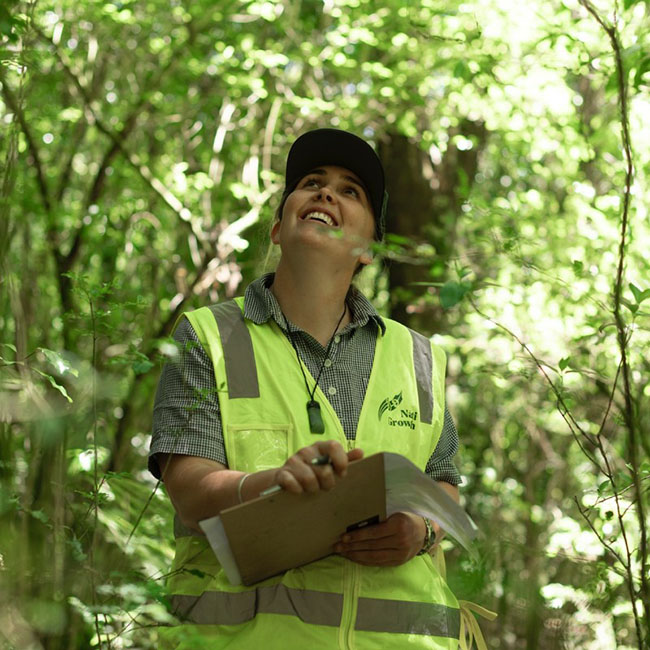
I certainly didn’t leave school thinking I would end up getting up at dawn and travelling around forests in pink hi vis! I studied health science and then found my way into forestry through an administration role. Getting out on site and understanding the work opened up a whole new direction for me. It was around the time that the New Zealand Health and Safety at Work Act was being finalised. Having completed a degree in health policy I was well positioned to help my workplace implement the new legislation. What drew me in was the people. You start to understand their challenges, hear their ideas, and see where you can help. Realising this was the right career for me came through those relationships and seeing people succeed. There is a real privilege in being part of making sure people get home to their friends and whānau, a Māori word for extended family and close family connections, each day. Once I made that connection, I was pretty well hooked.
You secured your first health and safety role operating in forestry and land management in 2017 and have worked in the profession ever since. What do you enjoy most about the career you have chosen?
The people, without a doubt. Over time, you build strong relationships, share plenty of laughs, and see people grow in confidence and take real pride in their work. I also get the best of both worlds. There is office work, of course, but most of the time I'm out and about with our kaimahi, a Māori word for workers, either in nature or at their place of work. I love that variety. Being alongside people gives me the chance to understand their challenges, hear their ideas, and work through things together. The crews get a bit of entertainment out of me, too. Pink is a staple of my wardrobe, so they generally see me coming. I'm not particularly tall, which sometimes means machinery needs repositioning so I can climb up to talk. One crew even kept a special stepping box on site for me, complete with handrails! Getting up and down the hills through the forest takes me longer too. Our region has some of the steepest logging terrain in the world, and my legs simply don't cover the same ground, so I must look rather comical trotting along at full pace trying to keep up with the guys. That sense of camaraderie, knowing we're all in it together, is something I really value. We can have a laugh and a bit of banter, while also knowing we have each other’s back if needed, or in my case, a leg up.
In 2021, you were the inaugural recipient of NEBOSH Gold Learning Partner IMPAC’s Emerging Safety Leader Scholarship, which provided a funded place on the NEBOSH International Diploma for Occupational Health and Safety Management Professionals. How did you find the experience, and what impact has achieving the qualification had on your career?
Being awarded the NEBOSH Diploma scholarship was someone backing my potential, and completing it helped me realise how much further I can take my health and safety career. I am not going to sugar-coat it though, the NEBOSH Diploma was a lot of work, but I loved the learning and embraced it wholeheartedly. I was studying alongside a full-time job, and there were plenty of late nights spent with textbooks, podcasts, lectures, and assignments. I should add that I had neither children nor a partner at the time, so I could dedicate the time the qualification requires. I have full admiration for anyone completing it while juggling those additional responsibilities.
Some subjects really stretched me, particularly areas such as advanced chemical handling and storage, where I had limited practical exposure. Working through those topics sharpened my critical thinking and strengthened my ability to apply knowledge across different situations. I was especially proud to pass first time.
Career-wise, the qualification gave me a stronger technical foundation to complement my practical experience. I became more confident explaining the reasoning behind my advice, asking better questions, and working through unfamiliar risks with a clearer understanding of what needed to be considered. That has been particularly valuable as my work has expanded beyond forestry into the wider businesses within Nāti Growth.
It also strengthened my credibility and opened the door to more challenging responsibilities. Being able to engage with the executive team and board, explain risks, and contribute to decision-making was a significant step for me. The Diploma helped prepare me for those conversations and gave me greater confidence in sharing my perspective.
Having an internationally recognised qualification has also broadened the possibilities for my career. It gives me options across industries and potentially overseas, while allowing me to bring that learning back to the rural communities I care so much about.
What was the best thing you learned through your NEBOSH studies?
Just how broad health and safety is. Biology, physics, chemistry, history, social sciences, it all turns up. As general practitioners, we are expected to understand, or at least be able to have an informed conversation about, everything from ergonomics and machinery to chemicals and human behaviour.
The biggest lesson for me was learning how to think critically across that breadth. To ask better questions, examine what is happening, and apply learning beyond the specific example in front of me. Something I studied in an unfamiliar context could still influence how I approached a problem in forestry.
It also reinforced the importance of recognising the limits of your knowledge. There is a huge amount to know in this profession and understanding when to bring in specialist advice is part of doing the job well.
You were appointed Health, Safety and Environmental Manager by Nāti Growth in 2024. Please tell us about the organisation and your role.
Nāti Growth is the commercial arm of Ngāti Porou, a Māori tribal group whose traditional homeland is on the East Coast of New Zealand's North Island. Nāti Growth provides sustainable returns for Ngāti Porou while creating opportunities for its people and communities to grow, develop, and prosper. The organisation is involved in a diverse range of activities including forestry, farming, fisheries, beekeeping, and property development. This means my role has a huge amount of variety, both in the work itself and in the people I get to work alongside.
We serve some very rural and remote communities. Reaching some of our sites in Ngāti Porou country can involve driving for up to three hours. You learn so much by standing alongside people and seeing what they are working with, so devoting that time to get to them and be present matters.
My role involves supporting people ensuring health, safety, and environmental considerations form part of everyday decision-making in the businesses we serve. One of my strengths is understanding the competing priorities on a site and bringing different people together to talk. Working through the practical realities helps us find solutions that people can genuinely put into practice.
I'm also very lucky to have a manager who champions my development and a board that is open to trying new things. They trust me to challenge their thinking and decision-making, which gives me a real opportunity to contribute.
You are known for taking a people centred approach to health and safety. What does this mean in practice, and how does it influence the way you work?
Well, there is usually a chocolate fish involved somewhere! I carry them around in my bag and keep a box in my desk drawer to recognise people who have gone above and beyond. My style is very much to lead with the carrot, although in my case the carrot is chocolate.
People switch off pretty quickly if every interaction is about something they haven't done. There are often competing priorities, practical difficulties, or simply human moments behind what you are seeing. You need to understand those if you want to help.
A chocolate fish is a small way of saying, "Thank you. I see you." That recognition matters. It then creates the opportunity for a conversation about what is proving difficult and how we can work together to resolve it.
Trust takes time. You must keep showing up, following through, and being there when things are hard. Those relationships make it easier to have honest conversations, including the challenging ones. I want people to feel comfortable telling me what is really happening, because that gives us something meaningful to work with.
In 2026, the New Zealand Institute of Safety Management (NZIM) named you as its Practitioner of the Year, having previously won the Emerging Practitioner award in 2022. What do you believe contributed to your success?
I have been told that I am the first person from my region, and the first representing the forestry, farming, and fisheries sectors, to win the overall title, so I am incredibly proud of the achievement. I'd like to think it reflects a genuine commitment to our people and a willingness to put in the work, especially when times are tough.
When the destructive Tropical Cyclone Gabrielle struck in February 2023, it was a frightening time. It was the deadliest and costliest weather event in New Zealand's history and brought logging operations in our community to an almost immediate halt, creating enormous uncertainty. When you live and work in a place like Tairāwhiti, the people affected are your crews, your friends, your neighbours, and their whānau. It hits very close to home.
In the period that followed, I invested a lot of energy in bringing women in forestry together, organising training, and creating opportunities to work through the challenges we were facing collectively. Alongside the Eastland Wood Council and industry partners, we helped women access funded health and safety qualifications. Twelve women completed Level 3, with ten set to progress to Level 4. For small businesses under pressure, access to that learning without the financial burden was significant. I'm particularly proud of that work. Those women take their knowledge and confidence back into their businesses, and the benefits extend far beyond the individual completing the course.
At Nāti Growth, I've also had the opportunity to help build a more consistent approach to managing risk across a diverse range of businesses. Having leaders who back me, people who trust me, and colleagues willing to work through challenges together has made so much possible. I'm proud of the recognition, but it reflects the efforts of many people, not just me.
What qualities do you think health and safety practitioners need to thrive in our profession?
Curiosity, empathy, critical thinking, and the ability to listen properly. You need to understand how people work and what they are trying to achieve, especially when several priorities are competing for their attention.
A big part of my role is bringing people together, understanding different perspectives, and helping them find a practical way forward. That takes patience, judgement, and sometimes the courage to ask the question everyone else has been avoiding.
You also need to be comfortable admitting when you don't know something and be willing to change your mind. Learning comes from all sorts of people, including those who have spent years doing the work you are there to understand.
And a sense of humour helps enormously. Being able to have a laugh and be yourself makes it easier to build relationships. You can take the responsibility of the work seriously while still enjoying the people you do it with.
What’s next for your own professional development?
I would like to continue progressing towards an executive role. I'm very well supported in that ambition by Nāti Growth, and I'm fortunate to have a fantastic manager who actively champions my development.
One thing I've learned is just how much influence senior management, the executive team, and the board have on workplace culture, strategic direction, and the decisions that determine how effectively risks are managed. I want to continue developing my ability to contribute at that level. There is still a great deal to learn, and that is what makes the journey so exciting.
How do you see the health and safety profession evolving over the next few years, and what opportunities and challenges do you think this will create?
I see massive opportunities for AI to take some of the fiddly administration off our hands. If that gives me more time on the ground developing people, understanding their work, and helping to resolve problems, I'm all for it. I'm not worried about my job. Critical thinking and the ability to engage with people will be needed for a long time yet. On any site, there can be several competing priorities, and understanding that context while helping people work towards a practical way forward takes judgement, communication, and experience. The challenge will be making good use of the time we gain. I want it to mean more conversations, more support, and more opportunities to develop our people.
I also want us to get better at explaining that health and safety is a fundamental part of good business and good people management. The road cones and box-ticking comments get me on my soapbox fairly quickly! So does the suggestion that everything was safer when people supposedly had more common sense. We live in the here and now, and we are responsible for the work and the people in front of us today. Every person deserves the basic human right to return home to their friends and whānau healthy, safe, and well every single day, and to enjoy that wellbeing long into the future.
What advice would you give to someone who is just starting their health and safety career?
Get out and spend time with the people doing the work. Ask questions, listen carefully and take an interest in their world. There is so much you can learn when you are willing to be the person who doesn’t have all the answers yet.
Build a network around you. Find people you can ring when you’re stuck, people who will challenge your thinking and people who understand the harder days. This can be a lonely role at times, particularly when you work remotely, so those connections matter.
Keep learning and give yourself time to develop. You won’t know everything straight away. You won’t know everything ten years later either!
Above all, remember who you are there for. Get to know your people, notice when they do something well and follow through when you say you will help.
A supply of chocolate fish certainly doesn’t hurt.
Keep caring and sparkle on - that would be my motto!