
From construction to offshore oil and gas: lessons from a decade in HSE
Case Study: Azhar Ali
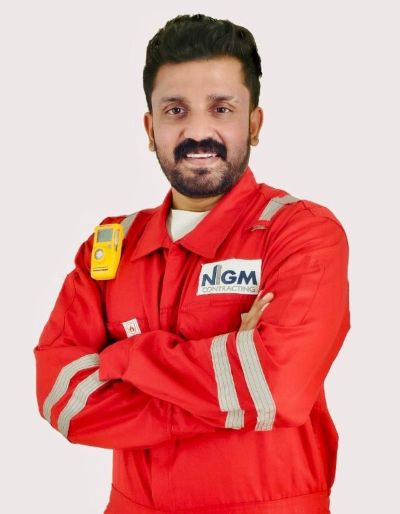
After completing the NEBOSH International General Certificate in 2016, Azhar Ali knew he wanted to take his expertise further. Today, as a joint 2026 Best Candidate in the NEBOSH Level 6 International Diploma Unit DI3, and an HSE Engineer working across ADNOC projects, he shares the experiences, challenges, and achievements that have defined his career.
What first drew you to the health and safety industry, and how did you know it was the right career for you?
From early on in my career, I knew I wanted to follow a path that was different from the conventional routes most people in mechanical fields take, such as QC, HVAC, NDT, or MEP. I had always planned to work in the Middle East, and as I began exploring opportunities in the region, health and safety stood out to me as a profession with genuine long-term potential.
My interest was first sparked during my university studies, where Industrial Safety was one of the subjects in our curriculum. I was immediately struck by how essential safety is to every aspect of life and work, not just as a technical requirement, but as something that directly protects people. I could see that to be successful, you needed a combination of technical knowledge and people skills, and this really appealed to me. Reading a risk assessment is one thing, but gaining genuine buy-in from a workforce made up of different nationalities, languages and backgrounds is another. The level of challenge that health and safety offers was also attractive. It demands constant problem-solving, sharp judgement, and the ability to influence people and processes.
When I started speaking to experienced HSE professionals, one qualification kept coming up as the benchmark: NEBOSH. It was clear that this was the internationally recognised standard I needed to build a credible career in health and safety.
I have now worked in the profession for more than ten years and have found that health and safety is a profession with no ceiling. It is constantly evolving and challenges you to keep developing your knowledge, qualifications and competencies to remain effective. That commitment to continuous growth, combined with the blend of technical and human challenge is what has kept me engaged. I also enjoy the satisfaction of knowing that our work helps people return home safely to their families each day.
You’ve recently been named the joint 2026 Best Candidate for the NEBOSH Level 6 International Diploma for Occupational Health and Safety Management Professionals, Unit DI3. Congratulations! Why did you choose this qualification, and how has taking it helped you so far?
I completed my NEBOSH International General Certificate back in 2016, and getting those results remains one of the happiest moments of my career. From that point on, I knew I wanted to go deeper and sharpen my technical knowledge to elevate my professional profile.
I had been planning to pursue the NEBOSH Level 6 Diploma for a long time, and it was never really a choice between multiple options. There are several Level 6 and even Level 7 qualifications available in the market now, and many of them are considerably easier to obtain than the NEBOSH International Diploma — but I wasn't looking for the easiest route. I was looking for a qualification that would genuinely test me, push me to gain deep knowledge through real effort, and at the same time carry the recognition to back that knowledge up, which the NEBOSH Diploma has. It’s the most recognised Level 6 qualification in the UAE, aligning for example with ADPHC’s qualification requirements to register as a Senior Practitioner. It also opens doors that matter to my long-term plan, including eligibility toward TSP status. These factors are why I'm confident that this was the right qualification for me to take based on my career aspirations.
Timing-wise, it also made sense. After almost a decade working across construction, oil and gas, steel manufacturing, and fit-out projects, I had enough field exposure to connect the theory in the Diploma to real situations I had already managed. This lived experience helped make concepts real rather than abstract.
Achieving the Diploma genuinely reshaped how I operate day to day. Working with leading clients like ADNOC across onshore and offshore projects gives me constant opportunities to apply what I have learned directly on site. The Diploma has given me much deeper knowledge of risk profiling and a far more thorough understanding of occupational health and industrial hygiene, areas I now draw on regularly in my daily duties. It has also given me noticeably more confidence when communicating technical points to clients, contractors, and management. I find I can now justify the "why" behind a control measure with proper technical grounding, rather than simply citing a procedure, meaning my input is taken more seriously in meetings and audits. Overall, it has strengthened my professional profile significantly.
What is the most valuable thing you learned through your NEBOSH studies?
Most incidents happen not because people don't know the rules, but because of gaps in how risk is assessed, communicated, and owned on the ground. Closing those gaps matters far more than adding another procedure. If there is one thing this journey has taught me, it is that continuous effort and dedication will always carry you ahead. Qualifications open doors, but it's consistency on the ground, day after day, that builds a better career.
Please tell us about your role as an HSE Engineer – what does your day-to-day entail and what projects are you currently working on?
I am currently working as an HSE Engineer with NIGM LLC, part of NCC Holding, on a portfolio of onshore and offshore projects delivered for ADNOC companies across Abu Dhabi. Our work is largely centred on civil building construction and temporary construction facilities located within live oil and gas fields, which means every project sits within a wider operational environment where the consequences of getting safety wrong extend well beyond our own site boundary.
A typical day starts before the workforce mobilises, reviewing the day's planned activities against the permits to work already issued, checking that risk assessments and method statements are current for the tasks scheduled, and making sure any high-risk activities such as excavation, working at height, or lifting operations have the right controls and supervision in place before anyone starts. Once work is underway, I spend a large part of my day on site rather than behind a desk, walking the work fronts, observing how work is being carried out against how it was planned.
Alongside the site presence, there's a steady stream of documentation and coordination that need to be managed. HSE statistics and regular reports for the client, close-out of actions from previous inspections or audits, and preparation of evidence to demonstrate compliance with ADNOC's HSE Assurance framework, which is far more rigorous than a standard contractor audit and requires continuous readiness rather than a once-a-month effort. I also spend time in planning and coordination meetings, flagging safety concerns in upcoming work stages before they reach the site rather than reacting once work has begun, and working with subcontractors to ensure their HSE arrangements align with the project's overall management system.
Investigations are another significant part of the role. Whenever there's an incident, near miss, or even a recurring unsafe condition, I lead the review to understand the root cause rather than settling for the surface-level explanation. I make sure the corrective actions that result are genuinely implemented, not just documented and closed.
One aspect of the role that I think doesn't get discussed enough is the relationship-management side of it. A large part of being effective is building enough credibility with supervisors and workers that they raise concerns to me directly, before something becomes an incident. That trust takes longer to build, but it's often what makes the difference between a site that's compliant on paper and one that's genuinely safe.
Each project has its own risk profile, so a meaningful part of my role is tailoring the HSE approach to the specific hazards, operational constraints, and stakeholder requirements of each site, ensuring that safety remains practical, proportionate, and effective throughout the project lifecycle.
You have over 10 years of health and safety experience across construction, onshore and offshore oil and gas, and steel manufacturing in the UAE and India. What advice would you give to make a transition between sectors a success?
Firstly, do not assume your technical knowledge transfers automatically. The core principles of risk assessment and hazard control remain the same, but the risk landscape can vary significantly from one sector to another. Moving from steel manufacturing into oil and gas, for example, meant shifting my mindset from primarily mechanical and process hazards to process safety, H₂S exposure, and the compounded risks of working in live, operational fields rather than in a controlled plant environment. Anyone who assumes their previous sector's priorities still apply is likely to overlook what matters on the new site.
Second, invest time in understanding the client's specific management system before trying to add value. Every sector, and often every client within that sector, has its own HSE framework, documentation standards, and assurance expectations. ADNOC's HSE Assurance Program and Corporate Practices, for instance, are far more structured and continuous than those I previously experienced in construction and logistics. Rather than trying to impose what had worked elsewhere, I made it a priority to learn the client’s system and standards first before trying to identify opportunities for improvement.
Thirdly, and probably most importantly, rebuild your credibility on the ground. I believe ten years of experience means very little to a new site team until you have demonstrated that you understand their risks, not just risk management in general. I have found that spending the first few weeks on a new project genuinely listening, walking the site, talking to supervisors and workers, and understanding day to day operations earns far more trust than arriving with fixed views on how things should be done.
In short, adapt your priorities to the sector, learn the system before attempting to change it, build trust on every new site, and maintain a strong technical foundation. That combination is what has allowed me to move between sectors successfully rather than just surviving the transition.
Looking back on your career to date, what achievement are you most proud of?
If I look back at everything I've done, it isn't a single moment that stands out as my proudest achievement. Instead, I’m most proud of my track record over the past ten years of delivering projects across multiple sectors without any major incident causing harm to workers or reputational damage to the companies I've worked for. In this profession, sustaining that level of performance is one of the hardest things to achieve, yet it ultimately is the most important measure of success.
To put this achievement into context, I started my career in India on a metro rail project shortly after completing my NEBOSH General Certificate. That early experience gave me a strong foundation in high-risk, high-pressure construction environments. When I moved to the UAE, I had the opportunity to work with major clients like ADNOC, TAQA, ADM, and TADWEER, across onshore and offshore projects. The workforces were from a wide range of nationalities and backgrounds, bringing additional challenges and opportunities. Being able to maintain a clean safety record throughout is something I do not take for granted.
It’s not something that has happened by chance. It’s the result of building a proactive safety culture on every site I've worked on, getting ahead of risks through effective planning, close coordination with project teams, and ensuring workers feel genuinely responsible for safety rather than simply complying with instructions. Success in health and safety is always a team effort, and my role has been to create the conditions where people look out for each other and take ownership of safe working practices.
Alongside that, I'm proud of how I've continued to invest in my professional development throughout my career, progressing from the NEBOSH General Certificate to the NEBOSH International Diploma, as well as completing several other qualifications and professional training. This commitment to continuous learning has enabled me to broaden my expertise, adapt to different sectors, and contribute more effectively to the organisations and projects I support.
What do you find most rewarding about working in the health and safety industry?
Seeing people go home safely in the same condition they arrived at work is what I find most rewarding. Working across construction, oil and gas, and steel manufacturing, I have been on sites with significant hazards including working at height, confined spaces, and live process areas. There is immense satisfaction in knowing that the plans, controls, and culture I helped put in place have contributed to shift ending without incident. It's not something anyone applauds at the end of the day, but it's the whole purpose of the job.
Beyond that, I find it rewarding to watch people's mindsets shift over time from viewing safety as a set of rules imposed on them to genuinely taking ownership themselves. Early in a project, workers often follow procedures because they are told to. However, when your efforts change how someone approaches a task, or when a worker stops a job themselves because something does not look right, that is the real measure of success. It means the culture has moved from compliance to ownership, and that shift doesn't happen without sustained effort.
I also find the role personally rewarding because this profession never lets you stand still. Every new project, client, sector, or set of challenges pushes me to keep learning and adapting. Very few careers demand that level of continuous growth while also giving you the opportunity to do something as meaningful as protecting people's lives and wellbeing.
What do you see as the biggest challenge facing health and safety professionals today?
The biggest day-to-day challenge is often securing buy in, particularly within execution teams. It is still common on some sites for safety professionals to be viewed as the ones creating obstacles or slowing progress, especially when projects are under pressure to meet demanding deadlines. The commercial pressures faced by both clients and contractors can add to this tension. There is still work to be done to ensure the HSE profession is recognised for the value it brings. Our role is to help work be completed safely while protecting both people and organisations from serious harm. Changing perceptions requires strong communication, relationship building and consistency in demonstrating how safety supports, rather than hinders, successful project delivery.
Site culture and leadership attitudes towards safety also have a significant impact. On projects where management genuinely backs the HSE function, that perception gap closes quickly because the workforce sees that safety and productivity are not competing priorities. Where that support is lacking, HSE professionals can find themselves facing an uphill challenge, regardless of how technically sound their plans may be.
What would your advice be to anyone at the start of their health and safety career?
Make sure you enter the profession with genuine passion and commitment, not simply because it appears to offer a stable career. Health and safety requires real dedication, because you are dealing with people's lives and wellbeing every single day. That commitment must come first, because it's what carries you through the more challenging aspects of the role.
Beyond that, invest in yourself continuously from day one. This profession offers enormous opportunities for those who are willing to put in the effort. There is always another qualification to pursue, another skill to develop, or another area of knowledge to build. There are real opportunities in this profession, but they only open up for people who commit to learning and upgrading themselves consistently, rather than stopping once they gain their first qualification or secure their first job.
I would also advise starting with a strong foundational qualification, such as a globally recognised NEBOSH qualification, as it provides both credibility and a solid technical grounding from the outset, rather than trying to learn everything informally on site. From there, get as much practical site experience as you can, even if it means starting in a junior position. Theory only becomes truly valuable when you see how sites operate, where the gaps between procedure and practice emerge, and how people respond to different approaches.
I would also encourage newcomers not to be discouraged if their input is not taken seriously at first. Credibility is earned over time through consistency and professionalism. Be patient, keep learning, and let your competence speak for itself.