
Finding my place in HSSE: A career change inspired by life experience
Case Study: Farah Firzanah Binti Yazid Imran
Farah Firzanah Binti Yazid Imran's route into health and safety was far from traditional. Having worked in healthcare and education before entering the profession, she discovered that many of the skills and experiences she had gained throughout her life aligned naturally with HSSE. Today, as an HSSE Advisor with Exceltech Solutions Sdn Bhd in Brunei Darussalam, she applies the knowledge gained through her NEBOSH studies to support workers, promote wellbeing, and help create safer workplaces.
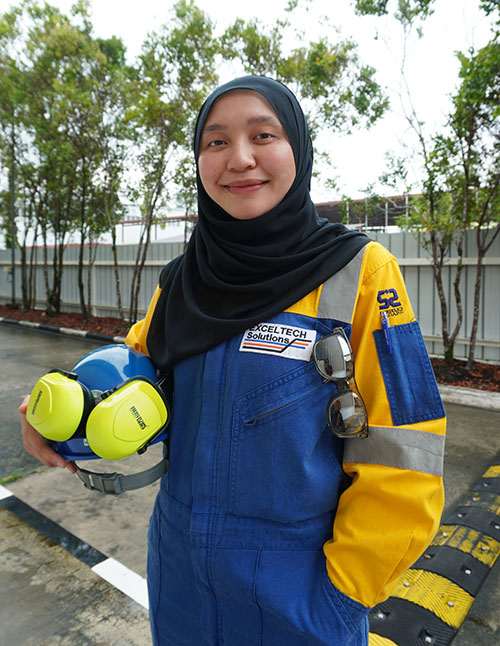
You originally studied Mechanical Engineering and later worked in education and healthcare. What first sparked your interest in health and safety?
I never really thought of myself as someone interested in health and safety. Looking back, though, I realise it has always been there in the back of my mind.
My father worked in the oil and gas industry, which meant I learned from an early age the importance of doing things carefully. My husband now works in the same sector and often shares stories about his work, including incidents, near misses, and the challenges involved in getting a job done safely.
In my own professional journey, it has always been there too, although I did not make the connection to health and safety at the time. During my Mechanical Engineering studies, I was exposed to different machinery and workshop activities, where we were taught to consider risks before carrying out a task. Later, as an educator, I learned the importance of following processes and doing things step by step. Then, while working in healthcare, I had to think about how illnesses could spread and what I could do to protect myself and others. These were all things I naturally thought about, but I never labelled them as health and safety.
Becoming a mother added another dimension to my thinking. I naturally started asking myself, "What could go wrong? What could hurt my child? And what can I do to prevent it?"
I realise now that I have been thinking about health and safety throughout my life without even knowing it. These experiences sparked my interest and ultimately led me to consider making health and safety my career.
During the COVID-19 pandemic, you were one of the shift's focal points in a hospital and were responsible for coordinating the response and associated logistics for your area. How did this experience influence your career aspirations and shape your interest in health and safety?
During COVID-19, the strict standard operating procedures taught me that a proper system is essential because one missed step can have consequences not only for yourself but also for those around you. As one of the shift's focal points, I learnt that accountability goes beyond completing a task. It meant taking a moment to check, ensuring everyone understood their responsibilities, managing swab transfers and logistics effectively, and communicating clearly rather than making assumptions.
The experience also showed me that even the smallest precautions matter. Wearing PPE correctly, answering a call promptly, or taking a second to double-check something could prevent a bigger problem further down the line. It shaped the way I view health and safety today. It is not always about dealing with obvious hazards or major incidents. Sometimes it is about the smallest things, even a tiny speck of a virus, yet those seemingly small risks can have a significant impact on both you and the people around you.
In 2023, you completed the NEBOSH International General Certificate in Occupational Health and Safety, studying with our Gold Learning Partner, Megamas Training Company Sdn Bhd.
- Why did you choose this qualification?
I completed an introductory health and safety course in October 2022, and it was then that I realised that health and safety was far more complex than it appears on the surface. I wanted to learn more and deepen my understanding, which motivated me to take the next step and pursue the NEBOSH International General Certificate.
I knew the qualification was a recognised and valuable certificate that could open opportunities to build a career in health and safety, so I challenged myself to go for it. Looking back, it was a decision that truly paid off, ultimately opening the door to a career in HSSE.
- Can you explain how achieving the qualification supported your career progression?
When I signed up, I did not have a health and safety background and was not working, but I was determined to take my interest further. I felt that achieving the NEBOSH International General Certificate and funding my own studies would demonstrate to potential employers that I was serious about building a career in health and safety.
Through my studies, I gained an understanding of how to approach hazards, risks, and controls in a structured way. This knowledge, combined with the confidence I gained, opened the door for me to enter the HSSE field and progress into the role I am in today.
In 2023 you also secured your first dedicated health and safety role with Exceltech Solutions Sdn Bhd. Can you tell us a little about the company and its approach to health and safety?
Exceltech Solutions Sdn Bhd (ETSSB) is a growing Bruneian company that offers fit-for-purpose solutions to clients in the energy industry. Our capabilities cover areas such as plant operations and maintenance, electrical and instrumentation services, cyber security, smart utilities, and renewable energy, with clients across the oil and gas and government sectors.
As a company, we place great importance on developing local talent and creating a safe and healthy working environment. Our HSSE approach is centred on Goal Zero, with a focus on preventing incidents, managing risks, and ensuring our people have the awareness, training, and tools they need to work safely. We also recognise that safety goes beyond incident prevention, which is why worker welfare is an important part of our approach. We strive to ensure that our people's wellbeing and basic needs are properly considered and supported.
As my first dedicated health and safety role, ETSSB has given me the opportunity to put the knowledge gained through my studies into practice while continuing to learn from real workplace situations and experiences.
What are your key responsibilities as a HSSE Advisor for the company?
As an HSSE Advisor, my role is to implement and monitor ETSSB's HSSE requirements and help keep safety practical and relevant in the workplace. My responsibilities include supporting and overseeing the HSSE aspects of projects, delivering safety inductions and toolbox talks, conducting site visits and inspections, coordinating training and awareness activities, and regularly communicating safe work practices, HSSE principles, company policies, and the 10 Life-Saving Rules. A key part of my role is advocating good safety practices and helping to build a culture where people feel comfortable speaking up, asking questions, and looking out for one another.
My role also extends beyond day-to-day safety activities. I support initiatives that promote psychological safety and worker wellbeing and help drive CSR activities that contribute to the health of our people and the wider community. These include blood donation drives and a psychological safety conference, delivered in collaboration with organisations such as SHENA and the Health Promotion Centre.
On the environmental side, I support and coordinate initiatives such as tree-planting activities, El Niño awareness campaigns, and coral-planting projects. For me, HSSE is not only about rules and compliance. It is also about how we work, how we treat people, and how we take responsibility for the environment around us.
In 2025, you completed the NEBOSH HSE Certificate in Process Safety Management, again choosing to study with Megamas. What motivated you to take this qualification, and how it has benefited you in your role?
I signed up for this course after being placed as a trainee HSSE Officer on our BLNG project. I knew our primary focus would be the delivery of electrical and instrumentation services, but this work would be carried out within a live process plant. For me, it was important not to look at our work in isolation, but to understand the environment we were working in and the potential hazards around us. I felt it was important to understand the different process areas, the hazards present, the emergency arrangements, and why certain controls were in place. I believed that having this awareness would help me recognise situations that could affect our work and, more importantly, enable me to better protect and support our crew.
Looking back, what was the most valuable thing you learned during your NEBOSH studies?
My NEBOSH studies changed how I see things and broadened my perspective. I began to look at what could lead to an incident, how it could happen, who or what could be affected, and what measures could be put in place to prevent it.
I learnt to look beyond the obvious. It made me think about what happens if one safeguard fails: is there another layer of protection, and are the measures in place actually effective? I started to understand that HSSE is not only about equipment, hazards, procedures, or systems, but also about the people involved. Their behaviour, decisions, communication, and the way they work all have a significant impact on safety.
NEBOSH showed me that there are many layers to HSSE, and understanding the system is only one part of it. To truly understand why things happen, you also need to understand the people behind the work.
What does being a health and safety professional mean to you?
To me, being a health and safety professional means thinking about what the work means for the people doing it. I try to look beyond the task itself and consider what they may be exposed to, how often they are carrying out the work, and whether it could affect them physically, mentally, or emotionally over time. It is not only about preventing something from happening today but also ensuring they stay safe and healthy in the long term.
It also means not treating safety as something that exists only on paper. Controls may be documented in a procedure or risk assessment, but we still need to know whether they work in practice. Are workers comfortable with the job? Do they feel safe speaking up? Is there something they are concerned about but have not shared? Do they have the support and protection they need beyond simply being provided with PPE?
For me, the role is about understanding both the work and the people doing it. Sometimes the factors that affect someone's safety are not immediately visible, so being observant, approachable, and willing to listen is just as important as understanding the relevant procedures and requirements.
How do you see your career progressing over the next five years?
Over the next five years, I intend to continue building on the strong health and safety foundations I have developed so far. As Exceltech Solutions Sdn Bhd grows, I expect there will be new opportunities and challenges that will support my development along the way. I am keen to work across a variety of project settings to broaden my experience and gain a deeper understanding of the risks present in environments such as corporate workplaces, process plants, and the maritime sector.
I have always aspired to be someone my colleagues can rely on when it comes to HSSE matters. My goal is to make well-informed decisions and provide practical advice that helps keep people safe. Seeking out new opportunities and experiences will continue to strengthen my technical knowledge and professional judgement, enabling me to make a greater contribution to the organisation.
At the same time, I hope to continue supporting and promoting Exceltech Solutions Sdn Bhd's strong commitment to safety and help reinforce that mindset across all levels of the company.
What do you see as the biggest challenges facing the profession today?
I would say the pace of change is one of the biggest challenges. Systems evolve, new technologies and interventions are introduced, and we are constantly working with different people who bring their own mindsets, experiences, and ways of approaching work. One challenge is that people can become comfortable with what they already know and may be hesitant to adopt new ways of working. Sometimes there is a mindset of “this is how we have always done it,” so encouraging people to see the value in change can take time.
At the same time, every project is different, with its own risks, working environment, and challenges. Finding the right approach for each situation, while maintaining the same high standards of safety, is something I find both challenging and rewarding.
The world is also changing in terms of technology, health, and environmental concerns. As health and safety professionals, we need to keep learning and stay aware of what is happening around us. What worked in the past may not always be the best approach today.
Another challenge for me is ensuring that safety does not become something people fear, find frustrating, or simply comply with because they have to. It should not become a paperwork exercise or something people become disengaged with. We need to find ways to keep safety practical, relevant, and engaging so that people understand its purpose and see it as an integral part of their work, rather than something separate from the job.
What advice would you give to someone considering a career in occupational health and safety?
My advice would be that no matter where you are coming from, there is always an opportunity to grow if you are willing to take it. I came into the safety field after being a housewife, so I understand how uncertain and a little scary it can feel when you are starting something new. There have been many times when I have felt out of my depth or felt like I did not know enough, and sometimes I still do. But I have learnt that it is okay not to have all the answers. What matters is being willing to learn, ask questions, listen to others and keep an open mind.
I would also encourage them to remember that health and safety professionals are not there to police people or work against the team. We are there to support people, understand the challenges they face and help them find safer ways to do their work.
Every workplace and every person can teach you something, so stay curious, do not be afraid to learn from others, and never assume you already know everything. There is always room to learn and grow in this profession.