
Building safer and more sustainable organisations through lifelong learning
Case Study: Dr Karthik Namadevan
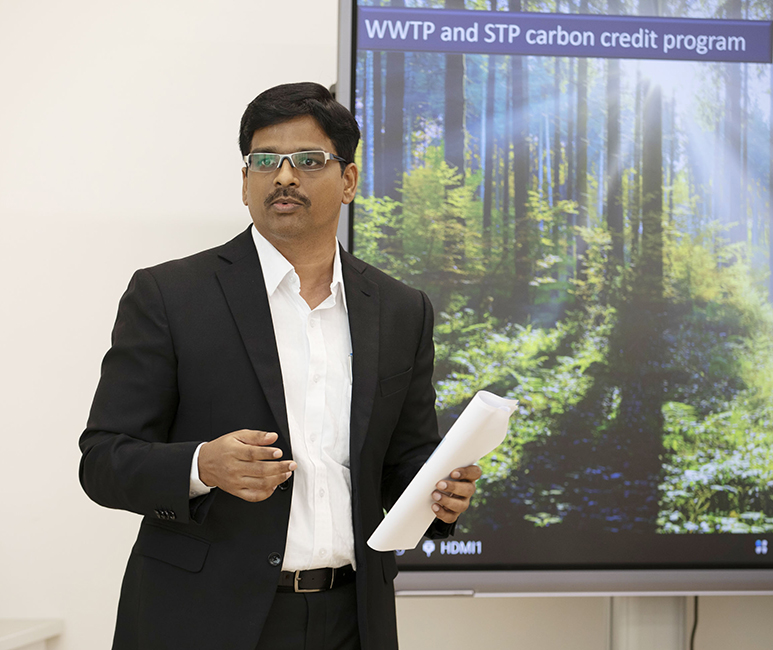
From a chemistry graduate working in manufacturing to a senior leader responsible for QHSE and ESG governance across multiple countries, Dr Karthik Namadevan has built an impressive international career. In this interview, he explains how NEBOSH qualifications, continuous learning, and a willingness to adapt have helped him navigate changing industries and a profession that now extends far beyond traditional health and safety.
When did you first decide to pursue a career in health and safety, and what sparked your interest?
My background in chemistry led me to a career in health and safety. I completed both undergraduate and postgraduate studies in chemistry at the University of Madras, and my first overseas role was as a QA/QC and HSE Engineer at a major nylon tyre cord manufacturer that relied heavily on chemicals and large-scale textile machinery.
On the shop floor, I saw first-hand how lapses in process safety, PPE compliance, and permit-to-work discipline could have serious consequences. This direct exposure to workplace risks inspired me to transition from a technical chemistry role into health and safety, a decision that has shaped my career ever since.
You passed your first NEBOSH qualification, the NEBOSH International General Certificate in Occupational Health and Safety, in 2012. Why did you choose it, and how did achieving this qualification help your career?
By 2012, I had several years of QHSE experience but saw the value in obtaining a formal, internationally recognised qualification, particularly as I was working with GCC operations and international clients. The NEBOSH International General Certificate was the ideal choice because of its global recognition and its structured approach to risk assessment and legal frameworks. The qualification complemented my hands-on experience and marked an important turning point in my career. Soon afterwards, I progressed to Senior QHSE Engineer and then Regional QHSE Manager roles, overseeing 12 sites across the GCC. The qualification provided the credibility and knowledge needed to support my move into regional leadership.
The following year you completed the NEBOSH International Diploma in Occupational Health and Safety. Can you tell us why you chose this qualification and what benefits you gained from this success?
After earning my NEBOSH International General Certificate, I wanted to deepen my expertise. The Diploma was ideal because the syllabus extends beyond operational practice and focuses on the strategic and managerial aspects of health and safety. As my responsibilities grew to include managing teams, advising senior leaders, and influencing policy and system design, this broader perspective became increasingly important.
The Diploma strengthened my strategic understanding of health and safety management systems and supported my work in developing and implementing integrated management systems across business units by bringing together ISO 9001, ISO 14001, and ISO 45001 requirements. This initiative has saved organisations tens of thousands of dollars annually through consolidated certification processes and reduced duplication of effort.
More recently, in 2021, you completed the Award in Environmental Awareness at Work. Why did you take this qualification, and was it useful?
By 2021, my role had expanded to include environmental and sustainability initiatives. I helped develop an Environmental and Social Management System (ESMS) aligned with International Finance Corporation (IFC) Performance Standards and worked with lenders such as the World Bank and British International Investment (BII) on environmental and social risk management.
I pursued the Award in Environmental Awareness at Work to formalise my expertise in environmental management. Although a shorter qualification, it reinforced key principles and strengthened my understanding as environmental governance became an increasingly important part of my role.
What has been the best thing you have learned through your NEBOSH studies?
Effective health and safety is not about ticking compliance boxes; it is about building systems and a culture that ensure people go home safely while delivering operational and business value.
You clearly have a real passion for learning, having completed numerous university degrees including a Master's and PhD. What drives this passion for lifelong learning?
I believe the QHSE profession evolves as quickly as the industries it serves, so remaining static is not an option. My academic journey reflects this. I hold a BSc and MSc in Chemistry from the University of Madras, a PhD in Chemistry with a specialisation in Nanotechnology, and an MSc in Sustainable Development from the University of Sussex. This last qualification became especially relevant as Environmental, Social and Governance (ESG) and climate risk became central to my work.
Each degree arose from a genuine need to address new challenges, whether in industrial safety, scientific discipline, or sustainability governance. For me, learning is not about collecting credentials; it is how I keep pace with an evolving profession. This approach has enabled me to move confidently into areas such as ESG governance and IFC compliance, rather than simply reacting to emerging requirements.
You have gained almost 20 years of health and safety experience operating across chemicals manufacturing, oil & gas, and water/utilities sectors. What advice would you give to others to ensure any transition between sectors is a success?
The key lesson is that while the fundamentals of risk management apply across sectors, the context will always differ. Assuming otherwise can quickly undermine your credibility in a new industry. When I moved from chemical manufacturing to oil and gas, and later to water and wastewater infrastructure, core principles such as hazard identification and management systems remained consistent. However, the specific risks, regulations, and terminology varied considerably. For example, oil and gas relies heavily on API standards, whereas utilities and concession projects are often governed by IFC Performance Standards and lender requirements.
My advice can be summarised in three key points:
- Learn the technical process: Before making changes, take time to understand the technical processes and operational realities of the new sector. Credibility comes from demonstrated knowledge, not transferred authority.
- Build relationships: Invest early in building relationships with operational teams and technical experts. They offer insights into the nuances of a sector that official qualifications may not address.
- Adapt your knowledge: Treat your existing knowledge as a toolkit to adapt to new contexts, not a rigid template. Each sector has its own risk profile and culture, and a one-size-fits-all approach rarely succeeds.
You were appointed Senior Corporate QHSE Manager in 2025 by Metito Utilities Limited. Can you tell us about the organisation and your role, please?
Metito Utilities is a global investor, developer, and operator of sustainable water management solutions and climate-resilient water assets. The company has built over 25 years of expertise in public private partnerships (PPP), having successfully delivered over 35 transformative projects across Saudi Arabia, the UAE, Qatar, Egypt, Uzbekistan, Rwanda, Serbia, and beyond.
I joined Metito Utilities as Senior Corporate QHSE Manager in 2025, after serving as Senior Corporate QHSSE Manager at Metito Group - the former structure comprising Utilities, EPC and Chemical divisions - where I led QHSSE initiatives across the Group for almost five years. This experience gave me a strong understanding of the business, its operations, and its strategic objectives.
In my current role, I oversee the Corporate QHSE and ESG functions across Metito Utilities corporate, project, and O&M operations. This includes responsibility for six operational assets and two projects under development located in the UAE, Saudi Arabia, Qatar, Rwanda, Serbia, China, and Egypt.
My responsibilities include managing the Integrated Management System (IMS), Environmental and Social Management System (ESMS), ESG governance, ISO certification, and compliance with the standards of international financial institutions and lenders. I also oversee sustainability reporting, corporate audits, legal compliance, and the maintenance of our corporate IMS, which is certified to ISO 9001, ISO 14001, and ISO 45001 by DNV across the group.
In addition, I am leading the development of our ESMS in line with International Finance Corporation (IFC) Performance Standards and the requirements of organisations such as the Multilateral Investment Guarantee Agency (MIGA), British International Investment (BII), and the African Development Bank (AfDB). I also led the implementation of Benchmark Gensuite, including digital modules for QHSE observations, action tracking, incident reporting, and sustainability reporting.
Furthermore, I regularly prepare ESG documentation, Environmental and Social Action Plans (ESAPs), and Annual Monitoring Reports (AMRs) for our international lenders.
Given the infrastructure sector in which we operate, I also support mergers and acquisitions (M&A) activities through QHSE due diligence and ESG risk assessments. In addition, I provide strategic QHSE and ESG advice to Executive Management and Board Committees.
In your opinion, what qualities do you believe a health and safety professional needs to be successful?
Technical knowledge is essential for entering the profession, but it does not guarantee long-term success. The most effective professionals combine strong analytical and auditing skills with the ability to influence others. Securing buy-in from site managers, board committees, or international lenders is often critical to success, and each of these audiences requires a different approach.
Resilience is equally important. There will be times when you face resistance while challenging unsafe practices or advocating decisions that may affect productivity in the short term. In these situations, you must have the confidence and conviction to stand firm.
Intellectual curiosity and adaptability are also critical. The profession now extends beyond traditional health and safety responsibilities to encompass environmental management, ESG governance, and digital transformation. Those who succeed are willing to continually broaden their knowledge and develop expertise across these areas, rather than focusing solely on compliance.
Is there a particular achievement in your career that you're most proud of?
I am especially proud of leading environmental governance initiatives that diverted more than 21,000 metric tonnes of waste from landfill, generating almost $1.8 million in savings. This achievement demonstrates that QHSE management should be viewed as an investment rather than a cost, that can deliver tangible business value whilst also improving health and safety.
I also take great pride in supporting teams that achieved 3, 5, and 10 million working hours without a lost-time incident across multiple projects, while maintaining zero work-related fatalities. Ultimately, what drives all this work is a commitment to ensuring that people return home safely.
Delivering training has been one of the most rewarding aspects of my career. Alongside my full-time roles, for nearly a decade I have worked as a part-time NEBOSH, IOSH, and ISEP-approved trainer and auditor. During this time, I have delivered more than 400 training courses to over 1,000 learners, totalling more than 16,000 training hours.
I particularly enjoy teaching the NEBOSH International General Certificate and International Diploma. Delivering these qualifications requires a deep understanding of the subject matter so that you can explain not only what needs to be done, but also why it matters, to learners from a wide range of industries and cultural backgrounds. Watching learners progress from being uncertain about basic risk assessment principles to confidently applying them in their own workplaces is one of the most satisfying parts of what I do. It is a direct and visible way of extending the impact of everything that NEBOSH has taught me throughout my own professional journey.
How do you see the role of health and safety evolving?
My role has expanded significantly throughout my career, and this trend is only accelerating. Health and safety once operated separately from environmental and quality functions, but leading organisations now integrate Quality, Health, Safety and Environment (QHSE), Environmental, Social and Governance (ESG), sustainability, and climate risk within a single governance framework. This evolution mirrors my own progression from QHSE Engineer to Corporate QHSE and ESG Executive.
Digital transformation is also reshaping the field. Implementing digital QHSE platforms has transformed how incidents are reported, tracked, and analysed, enabling leadership teams to make informed decisions using real-time data rather than relying on delayed reports. Stakeholder expectations have broadened as well. We are now accountable not only to regulators and clients, but also to international lenders, investors, and boards that scrutinise ESG performance as closely as financial results.
Looking ahead, successful health and safety professionals will need to combine technical expertise with commercial, environmental, and governance knowledge. They will need to be as comfortable discussing climate risk and lender requirements in the boardroom as they are managing operational risks on site.
What advice would you give someone who wants to build a career in the health and safety profession?
- Gain hands-on experience early by spending significant time at operational sites before specialising. This practical foundation gives credibility to your qualifications and helps ensure your policies are grounded in operational reality.
- Pursue recognised qualifications, such as those offered by NEBOSH, with a clear purpose. Align each qualification with your career development rather than collecting them for their own sake.
- Do not hesitate to move between sectors or into related disciplines such as environmental management or ESG. This breadth of experience is often what distinguishes exceptional health and safety professionals.
- Finally, develop your communication and influencing skills as seriously as your technical expertise. Even the most knowledgeable safety professional will struggle to make a meaningful impact without the ability to persuade others to change behaviours and adopt safer ways of working.