
“Health and Safety is deeply embedded in military life, even if we don’t always label it as such”
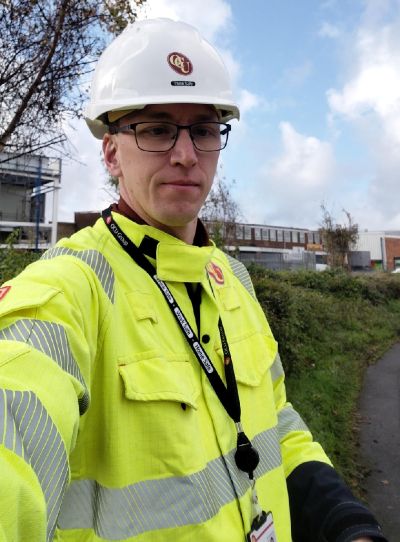
Case Study: Dan Maden
This case study has been created in collaboration with the Career Transition Partnership (CTP), which supported Dan during his move from the Royal Navy into civilian employment. CTP asked Dan a series of questions about his Service career, his transition experience and his move into a health and safety role, and Dan kindly agreed to share his story.
Can you tell us about your career in the Royal Navy?
I joined the Royal Navy in 2009 as a Marine Engineering Technician and, after completing technical training at HMS Sultan, began my career onboard the Type 22 Frigate HMS Cornwall, serving until her decommissioning in 2011. I then transferred to the Mine Countermeasures (MCM) flotilla, serving on Hunt Class Minehunters for the remainder of my career until leaving the Service in early 2026.
My final role was as the Deputy Marine Engineering Officer (DMEO) for MCM2 Crew 3, serving onboard HMS Ledbury in UK waters and HMS Chiddingfold in the Middle East. I was responsible for the day to day management of the Marine Engineering Department, ensuring the safe, reliable, and effective operation of all mechanical and electrical systems to meet operational demands.
This included leading the resolution of several high priority and long standing defects on critical systems such as diesel generators, the main switchboard, steering gear, and the ship’s air conditioning plant, many of which had previously prevented the ship from deploying. Restoring these capabilities was essential to maintaining operational readiness in a demanding and strategically important region.
Alongside my primary responsibilities, I served as Divisional Officer for the Marine Engineers, providing welfare support, career guidance, and professional development, particularly during extended deployments. I also oversaw departmental training, ensuring personnel competence and delivering coaching and mentoring to strengthen technical capability across the team.
In addition, I held the role of Assistant Safety, Health and Environment Officer, helping to ensure safe working practices and compliance so that the Ship’s Company could operate with minimal risk to themselves, others, and the environment.
What prompted your decision to leave the Service and transition to civilian life?
My transition to civilian life was driven primarily by the birth of my daughter and the increasing challenge of balancing family commitments with the demands of Service life. Extended periods away from home are an unavoidable part of naval operations, and although this suits many people, I felt it was the right time to prioritise my family and pursue a career that offered greater stability.
Before leaving the Service, I had significant concerns about securing employment, particularly around CV writing, interview preparation and understanding how to present my military experience in a civilian context. These uncertainties made the early stages of transition feel daunting.
Which NEBOSH qualifications do you currently hold and how have they helped you transition into a new career?
I currently hold the NEBOSH National General Certificate in Occupational Health and Safety. Completing this qualification was extremely useful as part of my transition from the Royal Navy into a civilian career. While I had extensive experience managing safety, risk and compliance throughout my military service, the qualification helped me to translate this into a format that civilian employers recognise and use.
Holding the NEBOSH General Certificate played a significant role in helping me secure my current position and I use skills learned from the course, such as hazard identification, risk assessment, incident investigation and the application of effective control measures daily.
The qualification not only supported my successful transition into civilian life but continues to provide practical value in my current role, helping me contribute to safer workplaces and positive health and safety outcomes.
How did you find the transition into the civilian job market?
I received support from the Career Transition Partnership (CTP), they helped me to translate my military experience and NEBOSH qualification into a successful civilian career. Through career consultations, CV reviews and interview preparation, I gained a better understanding of how to present my experience of risk management, safety leadership and compliance to civilian employers.
One of the most valuable aspects of the support was attending a CTP Employment Fair. It was there that I met representatives from OCU Group, an organisation and industry I had not previously considered as part of my job search. After discussing opportunities with them and submitting my CV, I was contacted a few weeks later and invited to interview.
The combination of CTP support, recognised qualifications and practical experience gave me the confidence to pursue opportunities within the Health and Safety profession. This ultimately led to me securing my current position as a SHEQ Advisor, where I apply the principles learned through NEBOSH daily.
Can you tell us about your current role?
I currently work for OCU Group, a leading Utilities and Energy Transition company supporting the upgrade and modernisation of critical national infrastructure, including power, energy and water networks. The organisation plays a key role in ensuring these systems are resilient, sustainable and capable of meeting future demand.
My role is Safety, Health, Environment and Quality (SHEQ) Advisor. I am responsible for ensuring compliance with relevant legislation, industry standards and internal policies across a range of operational sites. My responsibilities include developing and reviewing risk assessments to ensure work is planned and executed safely, conducting safety audits to verify compliance with standards such as ISO 45001 and ISO 14001, and leading incident investigations to identify root causes and implement corrective actions.
OCU Group’s motto, “Think Safe + Work Safe = Home Safe,” reflects the organisation’s commitment to protecting its workforce. I play a key role in promoting this culture and ensuring that every worker has the best possible chance of returning home safely to their families.
Why did you choose a career in health and safety?
I chose to pursue a career in health and safety because I am passionate about ensuring people return home safely at the end of each working day. During my Service, I witnessed several incidents that could have, or did, result in serious injury or loss of life. Many of those involved had families waiting for them at home, and the thought of the impact on those families has stayed with me.
This experience shaped my desire to help prevent such incidents and to contribute to creating safer working environments. That motivation naturally led me towards a role in health and safety.
What advice would you give to Service leavers considering a health and safety role?
My advice is to make full use of everything the CTP offers and to start early. Engage with the process as soon as possible and take advantage of Enhanced Learning Credit funding (ELC) and other funding streams. One thing I didn’t realise until I began my transition was that a single ELC can be used for multiple courses, provided they are delivered by the same provider.
Attend CTP Employment Fairs and speak to every organisation, even those you might not initially consider. Many industries have roles that align closely with military skill sets, even if they are not immediately obvious.
Finally, persevere. Job applications and interviews can feel daunting, but the skills developed in the Armed Forces — leadership, discipline, resilience, problem solving — are highly valued in the civilian world. Don’t underestimate the relevance of your experience.
Health and safety is deeply embedded in military life, even if we don’t always label it as such. From routine engineering safety rounds and cleaning routines to planning and executing high risk operations involving complex lifting plans and specialist personnel, the principles of risk management and safe systems of work are second nature to Service personnel.
These skills transfer directly into the civilian health and safety profession and are highly valued, but often underestimated by Service leavers themselves. The Armed Forces instil leadership, discipline and integrity, all of which are essential attributes for an effective health and safety professional.
One challenge I faced was doubting whether my skills would translate into a civilian role. What I have since learned is that the standards we work to in the military often exceed those in civilian industry. Don’t undersell yourself. Tasks you consider routine may be excellent examples to share in interviews.