
Building a Safety-First Culture in the Turkish Cement Industry
Case Study: Mustafa Erhan Arslan
Mustafa Erhan Arslan has spent more than two decades building a successful career in the cement industry, progressing from plant engineer to Plant Manager at Akçansa Çimento's Çanakkale Plant, a Heidelberg Materials subsidiary.
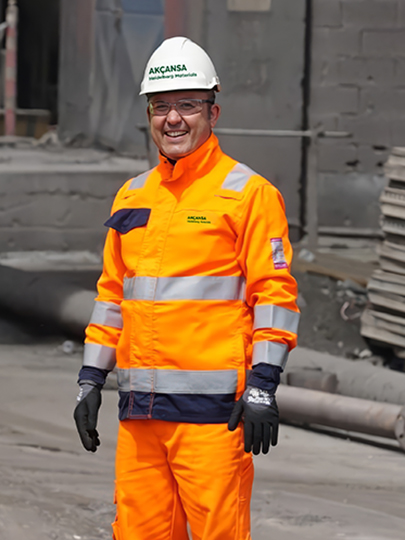
Mustafa Erhan Arslan has spent more than two decades building a successful career in the cement industry, progressing from plant engineer to Plant Manager at Akçansa Çimento's Çanakkale Plant, a Heidelberg Materials subsidiary. Responsible for managing complex industrial operations where safety is a critical priority, Mustafa chose to study the NEBOSH International General Certificate (IGC) with NEBOSH Gold Learning Partner Ege Consulting to strengthen his understanding of risk management and safety culture. In this case study, he reflects on his career journey, explains how the qualification has influenced his leadership approach, and shares why he believes visible management commitment is essential for creating safer workplaces.
Could you tell us a little bit about your background?
My career began in academia after I completed my Bachelor of Science degree in Mechanical Engineering. While studying for my Master of Science degree, I worked as a research assistant in the same department. During this time, I also had the opportunity to take part in industry-related research and development projects, which helped me build a strong link between academic knowledge and practical industrial applications.
After completing my master’s degree, I moved directly into heavy industry. It was here that I was first introduced to occupational health and safety in practice, while working in demanding industrial operations. Since then, health and safety has become an inseparable part of my professional life and leadership approach.
Mustafa, you have built your career in the cement industry. Can you tell us about this?
I have been working in the cement industry for 21 years, originally as a plant engineer and progressing to my current role as Plant Manager. For most of my career, apart from the last four years, I worked in the Project and Investment Department, where plant equipment systems are designed, engineered, and implemented. Four years ago, I was appointed Plant Manager and have been responsible for the full operations of the cement plant ever since. Throughout every stage of my career, operational management has been a central part of my role, and people have always remained at the heart of my work.
Cement production is a complex industrial process that transforms naturally mined raw materials through heat and heavy equipment. Electricity is another critical input, and the production system must operate continuously, day and night, on a shift basis. Employees are responsible for operating and maintaining the machinery safely and efficiently.
Logistics is also a key aspect of plant operations, as materials must be transported between different areas of the plant at every stage of the process. In my role, I coordinate people and resources, ensure that the plant continues to meet production requirements, and plan for both its short- and long-term needs, including investment, maintenance, and other operational requirements.
From a health and safety perspective, I am responsible for ensuring that operations comply with both my company's policies and the national legislation. Heidelberg Materials’ commitment to health and safety is very strict and structured, making it an especially important aspect of my role.
You have successfully completed the NEBOSH International General Certificate (IGC) with NEBOSH Gold Learning Partner Ege Consulting. Can you tell us why you chose to study this qualification and how it has helped you?
Throughout my career, I have witnessed the development of occupational health and safety in Türkiye, as well as across my industry and company. Over the years, national legislation has evolved, awareness has increased, the number of health and safety professionals has grown, dedicated health and safety departments have been established, training content has improved, key performance indicators have become more widely monitored, and zero-accident targets have become incorpoated into performance scorecards. Observing this shift from primarily operational priorities toward a safety-first mindset, and contributing to this ongoing journey, has made me more hopeful for future generations.
Protecting our people has always been central to my work. One of the first principles I learned while leading teams in heavy industry, where demanding and high-risk tasks are carried out almost every day, is the importance of guiding people to work safely. While improving the physical conditions of the workplace is essential, building a sustainable safety culture is even more critical. Safety culture is closely linked to people’s behaviours, attitudes, and habits, meaning occupational health and safety also intersects with psychology and sociology. For this reason, a clear methodology is vital for achieving lasting improvements in safety culture. This is why NEBOSH qualifications, with their proven global reputation, are especially valuable.
My journey toward studying the NEBOSH International General Certificate in Occupational Health and Safety began with a desire to explore a clear and structured methodology, particularly as I sought to strengthen the safety culture in my working environment. To be honest, I had not expected the programme to require such disciplined and demanding study. However, every topic increased my interest in the next. The main challenge was finding uninterrupted time to study during an especially busy period at work. Ultimately, earning the NEBOSH certificate was both a valuable achievement and an important learning experience that deepened my understanding of occupational health and safety. Throughout my studies, EGE Consulting excellent support and guidance, which contributed significantly to my success in achieving this qualification.
Can you share an example of a situation where knowledge gained from the NEBOSH IGC helped you solve a problem or improve safety in the workplace?
After an intensive period of study, I gained not only new knowledge but also the opportunity to review and challenge some of my previous assumptions and working methods. This helped me refine my approach to health and safety and provided a clearer direction for my professional development.
The risk assessment element of the course was particularly valuable because it showed me how to approach risk assessment in a more structured, systematic, and effective way. I now apply these principles in my daily work. For example, I have reviewed risk assessments across different production departments and shared several recommendations for improvement with colleagues based on the knowledge I gained through my studies.
The qualification has also influence how I communicate about health and safety. One of the key messages I took from the course was the importance of visible management commitment. This has shaped the way I engage with colleagues, as I now make a more conscious effort to demonstrate that health and safety is a genuine priority for me as a manager. In our meetings and day-to day interactions, I regularly draw on relevant aspects of my NEBOSH learning to reinforce safe working practices, raise awareness, and support the development of a more proactive safety culture.
What advice would you give to someone who is considering a career in health and safety or thinking about taking the NEBOSH IGC?
My advice to anyone considering the NEBOSH International General Certificate is to approach it with commitment and an open mind. It is not only a qualification; it is a structured learning journey that helps you understand risk, strengthen your leadership approach, and contribute more effectively to a positive safety culture.
As one of the first Plant Managers in the Turkish cement industry to achieve this qualification, I strongly recommend it to all leaders who place health and safety among their top priorities. Finally, I would like to thank my company, Akcansa Çimento, a Heidelberg Materials subsidiary, for its strong commitment to health and safety and for recognising that management commitment is essential for establishing and sustaining a positive safety culture.