
Building a career on assurance, auditing and safety excellence
Case Study: Syed Owais Mukhtar
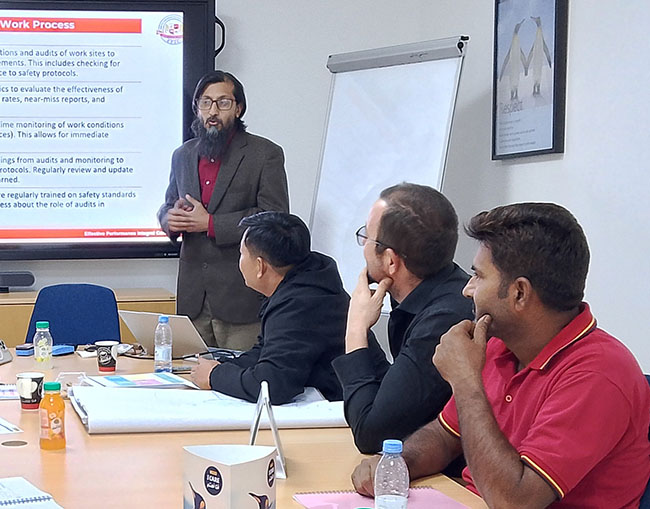
Syed Owais Mukhtar is a QHSE Lead Auditor and Consultant based in Riyadh, Saudi Arabia. With more than 15 years' experience in quality, health, safety and environmental management, he has conducted over 370 third-party audits for more than 250 organisations. In this interview, he discusses how the NEBOSH International General Certificate enhanced his technical knowledge, reflects on key career achievements and explores how AI could support the future of health and safety.
When did you decide you wanted your career to be in health and safety?
My career began in quality management. After graduating as an engineer, I started out in 2011 as a QMS Executive, developing procedures, work instructions and internal audit programmes. Working within operational environments taught me that management systems are only effective when they help protect people. Quality, safety and environmental performance are closely connected, and weaknesses in one area often indicate weaknesses in the others.
Over time, I moved from quality into integrated HSE-Q roles, and health and safety became the area where I felt I could make the greatest difference. A procedure on paper is not enough. What matters is ensuring that people go home safely at the end of every shift. That belief has guided my career ever since.
You have worked as both an in-house safety manager and a third-party auditor. What insights has this given you?
I have been fortunate to see safety from several perspectives. I have served as HSE Manager, including on large construction projects in Saudi Arabia, and I have audited organisations independently as a Lead Auditor.
In-house roles taught me what it takes to implement effective controls while working with busy teams and tight schedules. As a third-party auditor, I have worked with clients across a diverse range of sectors, including construction, manufacturing, logistics, healthcare, maritime, pharmaceuticals, utilities and shipping. Auditing taught me to view organisations objectively and helped me identify common patterns and challenges across industries. Combining these experiences allows me to provide advice that is both practical and technically sound. Today, as a consultant and trainer, I help organisations build effective management systems, prepare for certification and develop competent people.
Why did you choose to take the NEBOSH International General Certificate in Occupational Health and Safety?
I already had experience with management system standards, but I wanted a globally recognised qualification that focused specifically on practical occupational health and safety. The NEBOSH International General Certificate provided a structured, internationally relevant framework that I could apply across different countries and sectors. It is also widely respected by employers and clients around the world.
As someone who audits and advises others, I also felt a responsibility to keep strengthening my own technical foundation. Credibility matters in this profession, and the NEBOSH International General Certificate is a clear demonstration of competence and commitment to professional development.
How has gaining the NEBOSH International General Certificate in Occupational Health and Safety helped you?
It gave me a stronger technical foundation to complement my management system expertise by deepening my understanding of:
- Hazard identification and risk assessment
- The hierarchy of controls
- Incident investigation and root cause analysis
- Workplace and work equipment safety, including work at height and fire safety
- Health and welfare hazards
- Safety culture and human factors
- Monitoring, auditing and reviewing safety performance
It also improved the quality of my audit findings and recommendations. When I identify a nonconformity or an opportunity for improvement, I can link it more clearly to the underlying hazard and the most effective controls, rather than simply to a clause within a standard. This makes my feedback more valuable to clients and more likely to drive meaningful improvement.
The qualification has strengthened my work in ISO 45001 consultancy, internal auditing, certification readiness and safety training. It also complements my other professional credentials, including my IRCA Lead Auditor certifications.
What are you most proud of in your career?
I am most proud of having completed more than 370 third-party audits for over 250 organisations. Each audit provided an opportunity to understand a different organisation, challenge its practices fairly and help it improve. Many of those clients had never received an independent assessment of their risks before.
I am also proud of helping organisations achieve ISO certification, including supporting a major construction contractor working on a giga-project in Saudi Arabia to achieve multi-standard certification. However, what matters most to me is hearing that an audit or training session has changed the way people think about safety. Knowing that my work has contributed to a stronger safety culture is the achievement I value most.
You have an interest in how AI can support QHSE work. Could you tell us a little more about this?
Much of my day-to-day work involves three core activities: assessing risk, auditing management systems and training people. All three are knowledge-intensive and time-consuming, which makes them well suited to support from AI. I use AI as an assistant to handle some of the administration and research tasks, allowing me to spend more time applying professional judgement, making observations and engaging with workers.
AI in risk assessment. Producing a thorough risk assessment can be time-consuming, and the quality often depends on the assessor's experience. AI can help by:
- Suggesting potential hazards for activities such as work at height, hot work or confined space entry
- Prompting assessors with questions they may not have considered
- Recommending controls based on the hierarchy of controls
- Analysing incident, near-miss and inspection data to identify recurring hazards and trends
However, the assessor must still visit the workplace, speak with the people doing the work and verify every control. AI can provide a useful starting point, but it cannot replace professional competence.
AI in auditing and report writing. As a Lead Auditor, I have spent a significant amount of time documenting evidence and writing reports. AI can now support auditors by:
- Preparing audit plans and checklists tailored to an organisation and the relevant standard
- Reviewing large volumes of documents and records before an audit to identify potential gaps
- Drafting clear and consistent findings, summaries and corrective action requests from auditor notes
- Tracking corrective actions and identifying recurring nonconformities
The auditor remains responsible for the evidence, professional judgement and conclusions. Information must also be handled carefully, for example by using a locked-down AI system when working with client data and confidential records. Any AI-generated content should always be checked for accuracy before it is used.
AI in training and awareness. As a trainer, I have delivered courses covering topics such as fire safety, first aid, forklift operation and working at height. AI can help to:
- Develop training plans, presentations and learning materials more efficiently
- Create quizzes, scenarios and toolbox talks tailored to specific roles or workplaces
- Translate and simplify content for multilingual workforces, which is especially valuable in the Gulf region
- Produce posters and awareness campaign materials that can be adapted to different audiences
The real value of training, however, lies in the interaction. Practical demonstrations, discussion and feedback are what influence behaviour. AI cannot do that for us. It remains the trainer's responsibility to engage learners and ensure content is delivered in a way that is relevant and effective for the audience.
For safety professionals, the key question is not whether AI will affect our work, but how we can use it responsibly. The principles I learned through NEBOSH, such as understanding hazards, applying the hierarchy of controls and keeping people at the centre of decision-making, remain the benchmark for judging whether any new technology is truly making workplaces safer.
What advice would you give to anyone considering a career in health and safety?
Build a strong foundation first. The NEBOSH International General Certificate is one of the most respected starting points in the profession, and it gives you the knowledge, language and confidence to contribute from day one.
Beyond qualifications, I would encourage people to:
- Get out of the office and spend time with the people doing the work
- Develop strong communication skills, because safety is fundamentally about influencing people
- Learn how management systems work, as they turn good intentions into consistent practice
- Stay curious about new technology, including AI
- Never stop learning
The profession is changing quickly, but its purpose remains constant: making sure everyone returns home safely.