
Women leading the way in protecting people at work in the Middle East
Monday, 21 September 2026
NEBOSH qualified professionals are paving the way for more women to enter a career in occupational safety and health in the Middle East. In this article, we talk to some of them about their professional journeys, the challenges and opportunities they have faced, and what advice they would give to other women entering the profession in this part of the world. We also gain perspectives from NEBOSH and a leading female voice in safety and health at the International Labour Organization (ILO). Read on for inspiration – and a global call to action.
Introduction
The profession of occupational safety and health (OSH) remains male dominated. Surveys from membership bodies and recruitment agencies give the percentage of women in OSH or HSE (health, safety and environment) roles at between 20 and 25%.
And a gender disparity matters in the management of safety and health at work, say leading bodies and experts in the field. “When women are underrepresented, the profession loses essential talent and perspectives,” says Dr Manal Azzi, Head of OSH Policy, Evidence and Advocacy Unity, OSHE Branch, of the International Labour Organization (ILO).
In this article, we talk to women in OSH who have forged successful careers in the Middle East, an area in which the pronounced gender imbalance is economy wide. They are working in a wider region in which the average regional female labour force participation (FLFP) rate is just 19%, compared to 73% of men, says the World Bank Group. This compares to a global rate of 49%.
But these professionals are leading the way in a part of the world showing signs of progress towards more diverse, equitable workplaces. FLFP in Saudi Arabia rose by nearly 14 percentage points between 2017 and 2023, says the World Bank. In the United Arab Emirates, laws have been introduced to ensure parity in pay between men and women.
There is not enough statistical evidence to give a clear picture of the regional trend in OSH or HSE employment along gender lines, but we find evidence of the positive impact being made by women in safety in the Middle East among our NEBOSH qualified leaders. Here we talk to four of them about their career journeys, their take on progress made, and what tips they would give to other women embarking on an OSH career in the region. We then get viewpoints from NEBOSH and the ILO on what is required to move the dial on gender disparities in workplace safety and health.
Inspiration for a career in health and safety and first steps
First, what inspired our NEBOSH qualifiers to enter a career in OSH in the first place?
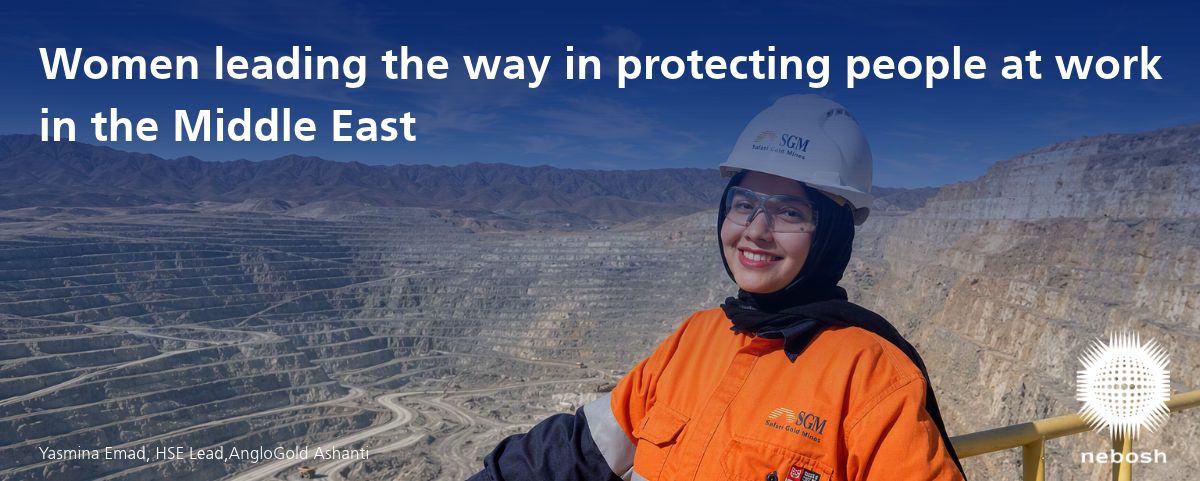
Yasmina Emad, HSE Lead and senior mining safety specialist for AngloGold Ashanti, in Egypt, says, “My journey in health and safety started when I was at university in my hometown, studying environmental science. One of the subjects we took was related to health and safety, and it really resonated with me. I realised I had a passion for risk management and protecting lives. I liked the idea that you can be directly involved in people’s lives and improve their health and safety at work. It was like a lightbulb moment for me.”
Thilini Amarapathy, a QHSE and document controller specialist for Emirates Transport in the UAE, says her inspiration for choosing health and safety came from a very simple place: “I’ve always been drawn to work that protects people. When I was young, I wanted to be a doctor because I liked the idea of helping people and making a difference in their lives. But under the Sri Lankan education system, I didn’t meet the cut off mark, so my path shifted.
“When I started working as a QHSE specialist in the UAE, I realised very quickly that safety has the same impact. You may not be treating patients, but you’re preventing hazards and risks, protecting workers, and making sure people go home safely every day. That sense of purpose really resonated with me.”
If purpose is a common driver, the first steps on an OSH career path vary widely among our NEBOSH qualified professionals. Yasmina set her sights on health and safety as a first career during her studies at university. For others, however, it is not their first job in employment.
In common with their male counterparts, women often move into OSH roles from all areas of industry or academia, using their experience and knowledge in specialist areas as a sound footing. Dr Rahaf Ajaj, now Associate Professor of Environmental Health and Safety - College of Engineering at Abu Dhabi University, took an academic route to safety via higher education. She says, “My path into health and safety didn't follow a straight line – it began with a degree in medical physics at UAE University and then a postgraduate diploma in radiation protection from the IAEA (International Atomic Energy Agency) in Vienna.” Rahaf became an HSE coordinator with the Supreme Petroleum Council, and later a member of the Federal Authority for Nuclear Regulation as a Health Physicist. Postgraduate studies in Canada then preceded a move back to the UAE for a career at Abu Dhabi University.
Thilini’s journey started in the UAE construction sector as a young environmental engineer. “Over time, my responsibilities grew beyond environmental work,” she says. “I moved into QHSE leadership roles across construction, energy services, transport, and sustainability. Working in these diverse industries helped me understand how safety culture, people’s behaviour, and leadership all connect.”
The platform provided by NEBOSH qualifications
And of course, an important career feature for these women as they developed into successful OSH professionals, was their NEBOSH qualifications. Both Yasmina and Rahaf describe qualifying as their ‘turning point’.
“It strengthened my CV, it made me more credible in front of managers, and it gave me the tools to respond immediately to hazards and manage them in a structured way,” says Yasmina. “On a personal level, NEBOSH helped me enhance my confidence and my professional identity. It also connected me with a wider network of safety professionals and opportunities.”
Rahaf, a Chartered Scientist, says, “It broadened me from radiation protection into the full spectrum of occupational safety and health, and it gave me a globally recognised language to work across industries and borders.”
Thilini says NEBOSH has played a key role that shaped everything that came after. From the International General Certificate “which gave me my first structured understanding of health and safety” to the Diploma that “directly supported my progression into roles where I implement integrated management systems, lead digital transformation, and influence safety across different departments.”
Gaining respect in male-dominated work environments
Typically for women in OSH in the Middle East, those first career steps are into male-dominated work environments.
“When I first went into a factory back in my hometown, I was told very clearly that there was no place for women,” says Yasmina. “Most people wanted a man because the job involved night shifts. In Egypt, it’s still Illegal for a woman to work night shifts, so I was immediately at a disadvantage. I had to learn how to implement safety in real life and, more importantly, how to persuade people and convince them of its importance – not just tell them what to do.
“I had to fight for my place. It was quite hard at first. The habits, the way of talking, how people accepted you in the field – it wasn’t very welcoming. But over time, they realised I wasn’t just playing at this job. I was working as hard as they were.”
Rahaf Ajaj says her biggest challenge early on was credibility. “Walking into a facility as a young woman inspector and having to prove, every time, that I belonged there,” she says. “What helped was letting the science speak. Competence is the great equaliser.”
Professionals like Yasmina, Rahaf and Thilini have found a blend of technical competence and human skills, such as leadership and communication, is a solid foundation for a career in OSH.
“Being a young woman on construction sites in the Middle East in 2007, I had to work harder to earn credibility,” says Thilini. “Those early years taught me professionalism and how important it is to stay calm and consistent when you’re responsible for people’s safety. Working in a male dominated industry at that age meant I really had to prove myself on high risk sites to survive.
“Sometimes people didn’t expect me to lead safety discussions or make technical decisions. So, I learned to be very consistent, confident, and well prepared. I realised early on that competence is the strongest way to break assumptions.”
But a rounded skills set is not everything. Brenda Lumanlan, Vice President - HSSE & Sustainability at Dubai-based Future Pipe Industries, attributes her successful first steps in a predominantly male work environment to something else. "You worry that they won’t value what you say because of your gender,” she says. “But once you start talking and they understand that you’re speaking because you genuinely care about them, even if you’ve never met them before, that changes everything. It’s very easy to see when you speak from the heart. When your concern for their health and wellbeing at work is genuine, they listen.
“That experience taught me something I've carried throughout my career: influence in safety doesn't come from your title or gender; it comes from credibility, relationships and understanding the people you're trying to protect.”
Is enough progress being made in addressing the region’s gender imbalance in HSE?
The NEBOSH qualification holders we spoke to indicate that the progress is being made toward a more balanced health and safety workforce, but it is a mixed picture.
“I've seen real progress in the UAE,” says Rahaf, who has mentored women in the profession there. “Emirati and Arab women are now leading in nuclear regulation, oil and gas HSE, and academia – and national leadership has actively championed this. But representation at senior levels still has room to grow, which is why mentoring matters so much to me.”
Brenda says, “It’s progressing, but in my view it's not at the rate other countries are experiencing, if we focus just on the occupational health and safety profession.”
She points to the cultural context and understanding and respecting different cultures and ways of working. “But I've seen a lot of positive change,” says Brenda. “The UAE, Saudi Arabia and Oman are putting much more focus on sustainability, social responsibility, diversity and inclusion. I think this will also create more opportunities for women. We may not see many women yet in some operational safety roles, but I believe that will change, and we'll see more women entering the profession and progressing into leadership.”
Thilini sees signs of progress, too. “I see women working confidently across construction, energy, transport, sustainability, manufacturing, and even entertainment,” she says.
“Organisations are much more open to hiring women in technical and leadership positions. In the UAE there is a clear push towards diversity and inclusion. Companies recognise that women bring strong communication and collaboration skills that directly improve safety culture.”
The work of organisations like NEBOSH in promoting female role models in OSH has also been important, says Thilini. “I also try to contribute to this progress by mentoring younger women entering the field,” she says. “Many of them face the same challenges I faced years ago, and sometimes all they need is someone who understands the journey and encourages them to step forward.”
The importance of a support network
The support of family, friends, co-workers and mentors has been central to the career successes of the professionals we spoke to for this article.
“My friends and my family were the ones who supported me through the toughest parts of the journey,” says Yasmina. “Without my mother and my father, I wouldn’t be here. There was a moment when I said, ‘That’s enough. I don’t want to continue this anymore.’ But they encouraged me, and that helped me keep going.
“When I decided not to give up, my whole mindset changed. And when my mindset changed, the way people looked at me changed too. That made a huge difference.”
Thilini believes mentoring and networking have played a major role in her growth. “I’m an active member of the NEBOSH Alumni Group, which has connected me with OHS professionals globally and given me access to supportive networks, including NEBOSH WhatsApp communities where practitioners share insights and guidance,” she says. Thilini actively uses LinkedIn and is a member of professional bodies, such as the International Institute of Risk and Safety Management (IIRSM) and Chartered Management Institute (CMI).
“Networking is very important because it forces you out of your comfort zone and helps you see risk from different perspectives,” she says. “I might see a risk one way, but when you’re in a network you hear how others see it, and that’s especially important for women.”
Brenda says her ability to build relationships with her co-workers has been instrumental in her career. "New generation safety leadership is not just about knowing physical risks anymore,” she says. “To be successful, you need to be a good communicator, you need listening skills, you need empathy, and you need to be able to work with people at all levels. No matter how good your strategy is, if you don’t have strong influence and relationships, with your boss, with your team, and with people at all levels, from the cleaner to the CEO, you won’t be successful.”
Advice for women beginning their HSE career in the Middle East
Our qualification holders have insights and encouragement for you if you’re a woman considering a career in OSH or HSE in the Middle East. “Don't wait to feel ready,” says Rahaf. “This region needs your perspective – safety is about protecting people, and diverse teams see risks that homogeneous ones miss."
Yasmina says, “I don’t want to be cliché and just say, ‘Be strong and don’t give up,’ even though that’s true. My main advice is for women to invest in their own technical knowledge and in themselves. When you do that, you build real confidence, and that confidence carries you through a male dominated environment.”
Thilini says, “Go for it. Health and safety is a field where your voice, your perspective, and your leadership genuinely matter. Women bring incredibly valuable skills like communication, empathy, attention to detail, and a collaborative approach.”
Brenda agrees with Rahaf. “Don’t wait until you’re completely ready,” she says. "By nature, women often feel they have to be fully prepared and know everything before they step into a role. Women tend to make sure they’re very well prepared, but that can hold them back.
"If you’re thinking of going into health and safety, you need to touch your heart first and ask if you’re really passionate about it and about caring for other people. Of course, it's a career and we all need to earn a living, but if money is the only reason, you're missing the best part of the job.”
Dee Arp, Chief Quality Officer at NEBOSH, has experienced being the only woman in the room as a safety trainer, and has been a prominent champion of women in OSH. The advice of our featured qualification holders is echoed in her message to women embarking on a career in safety and health: “If you know your stuff, you’ve done the training, you’ve completed your qualifications and you’re gaining experience, you just need to know that you’re enough.
“Being a professional anywhere in the world, it can feel quite isolating. When you first join a big organisation, it can be a lot. There's a lot of expectation, and I think women sometimes put even more expectation on themselves.
“Knowing that you’ve got that foundational knowledge is important. Be confident. But also find your mentors, find your networks, and use them.”
A call to action
Historically, OSH or HSE has been a male domain, focused largely on safety issues in highly hazardous sectors, such as mining and construction, says Dr Manal Azzi. As progress was made on safety, health increasingly came to the fore, which broadened the multidisciplinary nature of OSH and attracted both women and men from different scientific and technical backgrounds.
“Nevertheless, as in many scientific and technical fields, there continues to be less recognition and respect for what women bring to the table,” says Manal. “It is rarely said openly, but it is felt by many of us. I personally enjoy working in OSH because it is such a rich and varied field, covering every sector and having a real impact on the lives of workers, their families and communities.
“When women are underrepresented, the profession loses essential talent and perspectives. We need more women across technical, operational and leadership roles, both to strengthen the profession and to bring us closer to understanding and responding to the diverse realities of workers around the world."