
When a mentor sees your potential before you see it yourself. Brenda’s journey from Executive Assistant to Global VP-HSSE
Case Study: Brenda Lumanlan
When Brenda Lumanlan moved to Dubai from the Philippines, the first role she secured was as a receptionist and executive assistant. After the Vice President of HSSE recognised her potential, Brenda was encouraged to consider a career in health and safety. Under his mentorship, she sought out every opportunity to learn and progress, a focus that has continued throughout her career. Fast forward to today, and Brenda is now Global Vice President of HSSE and Sustainability at Future Pipe Industries. In this interview, we explore her career and the part NEBOSH qualifications have played in her success.
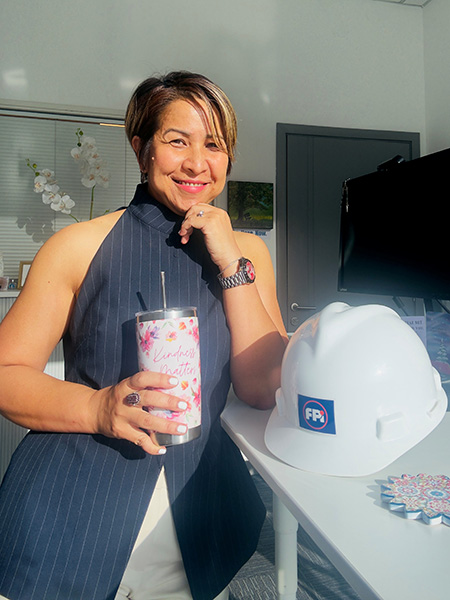
When did you decide you wanted to work in health and safety, and how did you secure your first opportunity in the profession?
My journey into health and safety was unexpected. When I moved to Dubai, I initially worked as a receptionist and Executive Assistant, supporting the Vice President of HSSE, Robert “Bob” Egan. Over time, he became much more than a boss. He was my mentor, my coach, and remains a very good friend to this day.
Bob encouraged me to explore safety as a profession. He explained that while there were many women in administrative roles, there were very few in safety leadership positions. That conversation stayed with me and slowly changed the direction of my life.
I began learning, studying, and volunteering for health and safety related opportunities. I spent time with those on the tools, learning about their realities. Like me, many had left their home countries to provide for their families. I began to realise that safety is more than compliance and procedures. It is about protecting people, listening to them, and helping to create workplaces where individuals feel respected, valued, and safe. What better job is there than health and safety, where we are paid to care for people?
Why did you choose the NEBOSH International General Certificate, and how did it help your career?
In 2013, Bob moved to an international oil and gas company to oversee Eastern Hemisphere operations. He invited me to join the organisation to work alongside him once again, but this time not as his assistant. He wanted me to become a QHSSE Specialist, with one condition: I had to achieve the NEBOSH International General Certificate.
At the time, almost every safety role I came across required NEBOSH, so I knew it was important. More than that, I wanted to build my confidence and strengthen my technical understanding of health and safety.
Passing the qualification in 2013 opened many opportunities for me. I went on to gain experience auditing and delivering training in gas plants, in manufacturing facilities, and in operational environments across multiple countries.
How did the NEBOSH Fire Safety qualification support your career and development?
I quickly realised how critical fire safety is in the gas plants and compression facilities I was working in. The NEBOSH Fire Safety certificate helped me to better understand the risks from a practical and operational perspective. It strengthened my awareness of emergency preparedness, prevention, and critical controls, and reinforced the importance of being proactive. The more I learned, the more I understood that health and safety is a continuous journey of learning and improvement.
You went on to complete the NEBOSH International Diploma, studying for a second time with NEBOSH Gold Learning Partner, RRC International. Why did you choose this qualification and what benefits did you gain?
I chose the NEBOSH International Diploma because I wanted to challenge myself and deepen my knowledge. At that stage of my career, I was already supporting regional and international operations, and I wanted my experience to be underpinned by stronger technical understanding.
Completing the Diploma was not easy. At the time, it involved face to face learning, written exams, and long nights of reading. I had to find time for my studies while working full time, travelling for work, and raising two young children. The experience taught me discipline, resilience, kindness and humility. My studies also changed the way I think about leadership, governance, risk, and organisational culture.
I still remember attending my graduation in the UK with my husband. It felt like a joint celebration, as he had supported me throughout my studies. For us Filipinos, education is a very important achievement, so it was a proud and emotional moment for our family.
That same year, I was promoted into a regional HSSE leadership role. Looking back, I believe the qualification helped me grow both professionally and personally.
What is the best thing you have learned through your NEBOSH studies?
One of the biggest lessons I learned is that health and safety is ultimately about people. Technical knowledge, systems, and procedures are all important, but strong safety cultures are built through trust, communication, leadership, and genuine care for people.
I remember a colleague saying to me before one of my exams: “Passing the exam is one thing, but the real test is how you apply what you learn and share it with others.” That advice has stayed with me throughout my career.
What qualities help someone become a successful H&S professional?
Our profession is a noble calling. To be successful I feel you need to be accurate and truthful and go beyond compliance, to strive for what is morally right. We need to serve with our hearts.
A speaker at a conference I once attended rightly told the audience that safety professionals are in the relationships business. Technical competence is important, but so is humility, empathy, communication, and relationship-building.
As health and safety professionals, we work with people from different cultures, backgrounds, and life experiences. If people feel that you genuinely care about them, they are more willing to trust you, speak up, and work with you to bring about positive change.
Safety is not just about rules and compliance; it’s also about dignity, care, fairness, and leadership responsibility. As the poet Maya Angelou said:
“People will forget what you said or what you did, but people will never forget how you made them feel.”
We need to show our workers that they matter and that we care to ensure they buy in to safety.
Can you tell us about Future Pipe Industries and its health and safety ethos?
Future Pipe Industries (FPI) is a global leading manufacturer specialising in advanced composite pipe solutions. With more than 40 years of history, the organisation brings together experienced people, established operations, and a strong legacy within the industry.
FPI has been on a significant health and safety journey in recent years. Our culture is evolving and is becoming focused on both safety and care. This progression has been built on visible felt leadership, trust, and workforce engagement. Our leaders and managers demonstrate their commitment to our human centred approach through conversation and action. This has helped to create workplaces where people feel comfortable speaking up, stopping unsafe work, learning from one another, and genuinely looking out for each other every day. For me, this is how safety becomes real and sustainable over time.
Our in house health and safety expertise has also been significantly strengthened, with several HSSE professionals being appointed across the business in recent years. Those in HSSE Manager roles have been encouraged to complete the NEBOSH International Diploma, and six of out of eleven have already achieved this goal.
More widely, the organisation’s approach to health, safety, security, environmental stewardship and sustainability has been enhanced by the rollout of a new integrated management system. A programme of audit verification and training has been devised for colleagues at all levels of the business to ensure its implementation is effective.
At FPI, collaboration among all functions is actively encouraged, especially between the operations and HSSE teams. Health, safety, and environmental considerations are embedded into operational and engineering decisions from the outset and are never treated as an afterthought.
It has been wonderful to see the progress that has been made since I joined the organisation in 2023, and I know FPI’s continuous improvement ethos will mean there are many more positive developments to come.
What are your main responsibilities as Global VP – HSSE and Sustainability?
My role focuses on supporting the organisation in strengthening its approach to health, safety, security, environment, and sustainability across its global operations. More recently, this has included strengthening awareness within FPI of security, travel risk, and duty of care, particularly during periods of regional instability. Collaboration with leadership teams and external partners, such as International SOS, has helped support our people and operations across multiple locations, including higher-risk environments.
A large part of my role involves bringing people together, encouraging collaboration, and helping teams move towards shared goals. I work closely with leadership teams, HSSE professionals, operational teams and external partners to strengthen governance, duty of care, improve workforce engagement, support sustainability initiatives, and further develop our culture so that people always feel respected, supported, cared for and empowered to speak up.
I am fortunate to work with an excellent corporate HSSE&S team, where each person brings strong expertise in areas such as management systems, engineering safety, environmental management, and sustainability. We are further supported by experienced HSSE leaders and teams across our 11 manufacturing facilities, whose operational knowledge and commitment are essential in turning plans into meaningful improvements across the organisation.
Over time, I have realised that I do not need to be the smartest or most technical person in every room. My strength often lies in connecting people, building genuine trust, and helping teams move forward together.
What do you enjoy most about being part of the health and safety profession?
For me, the most meaningful part of this profession is the opportunity to positively influence people’s lives.
I value the relationships built along the way — learning from workers, supporting leaders, mentoring younger professionals, and helping to create workplaces where people feel valued and cared for.
Health and safety is not only about preventing incidents. It is about protecting people’s wellbeing, dignity, and quality of life.
What advice would you give to someone starting their health and safety career?
Never stop learning and never underestimate the importance of genuine connections and communication.
Do not be discouraged if you lack knowledge or confidence at the beginning. Growth happens through experience, continuous learning, and the support of mentors and colleagues who believe in you.
Looking back on my own journey, I never imagined it would lead me to a global HSSE leadership role. The belief and support others have shown in me has been key to my success. Building your network is vital, as it is a source of mutual guidance and support.
Technical knowledge is important, but life’s core values such as kindness, humility, integrity, and the ability to connect with people will take you very far in this profession.
Stay curious. Stay humble. And remember that every opportunity to help people work safely truly matters.