
Transforming Safety Culture: One Engineer’s Path to Strategic HSE Leadership
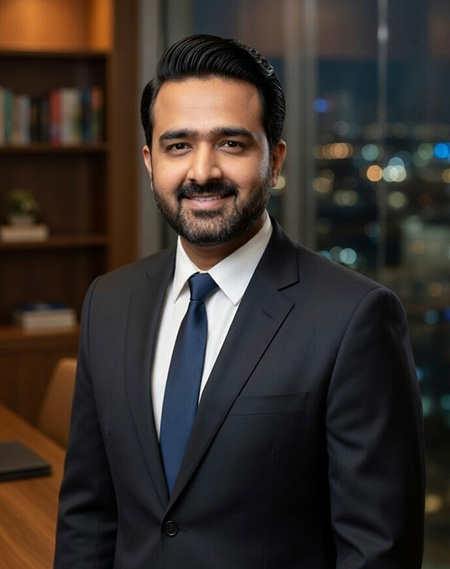
Case Study: Muhammad Ibad Siddiqui
As a petroleum engineer who built his career in some of the world’s most challenging oil and gas environments, NEBOSH Diplomate Muhammad Ibad Siddiqui learned early that technical excellence means nothing without safety excellence. This case study explores the lessons that continue to guide his approach to health and safety to this day.
As a qualified petroleum engineer, health and safety will always have been a key consideration. Can you share how it became your main focus?
That’s 100% correct. Safety was always integral to my engineering work, but it became my primary focus through organic progression. Early in my career, when I worked for Schlumberger and Mari Petroleum in Pakistan, I was a team member on Hazard Identification and Task Risk Assessment (HITRA) exercises.
The real shift came at United Energy Pakistan, where I had the opportunity to become a HITRA Team Leader. This meant I was responsible for developing and approving risk assessments for all well interventions. That level of accountability changed my perspective, and I realised my key focus should always be ensuring every team member returned home safely.
The transition crystallised at Bunduq Oil Company in Abu Dhabi, where I supervised offshore wellhead platforms in extremely high H₂S environments (15%, i.e. 150,000 ppm). There, safety was existential, not procedural. I realised that technical competence alone is insufficient without robust safety management systems.
Today, I do not separate my petroleum engineering identity from my identity as an HSE leader. I engineer safe operations and manage safety with an engineer’s precision.
In your career you will have worked in several challenging environments. Would you be able to share insights to help others get the job done in similar circumstances?
Absolutely. I have worked offshore in high H2S environments (up to 150,000 ppm), supervised rigless well interventions on oil and gas wells, both onshore and offshore, and led QMS and HSEMS implementations from scratch. Three insights guide me daily:
- Never separate technical competence from safety discipline
- Invest in frontline training; a competent worker who understands why a rule exists will follow it, even when no one is watching.
- Lead systematic incident investigations not to assign blame, but to fix systems and prevent recurrence. Recurring problems are almost always system failures, not individual errors.
You passed your first NEBOSH qualification, the NEBOSH International General Certificate in Occupational Health and Safety, in 2021. Why did you choose it and how did it help your career?
I chose the NEBOSH International General Certificate because it is globally recognised as the gold standard and a foundational qualification in occupational health and safety. It offered a structured, principles based approach rather than piecemeal training.
Achieving this qualification became the catalyst of my career transition from petroleum engineer who considered safety to an industry professional competent in safety management. It gave me the confidence to become a QHSE trainer, before progressing into a QHSE Manager position.
You went onto complete three other NEBOSH qualifications before taking on the Diploma. Can you provide details?
The three NEBOSH qualifications I completed prior to undertaking the NEBOSH Diploma were:
- NEBOSH IIRSM Certificate in Managing Risk — Strengthened my understanding of enterprise risk management beyond operational HSE. It enabled me to align safety priorities with wider business strategy, particularly during management review meetings.
- NEBOSH HSE Certificate in Process Safety Management — Essential for my high H₂S offshore background. It provided structured tools for managing major accident hazards, maintaining barrier integrity, and preventing mechanical loss of containment.
- NEBOSH HSE Introduction to Incident Investigation — Transitioned my approach from basic root cause analysis to more rigorous methodologies (e.g., barrier analysis, change investigation). This directly improved Nonconformance report (NCR) handling, complaint resolution, and the overall incident investigation process at Al Ahlia.
In 2026 you completed the NEBOSH Level 6 International Diploma for Occupational Health and Safety Management Professionals. Can you tell us why you chose this qualification and what benefits you gained from this success?
I chose the NEBOSH Level 6 Diploma because I had outgrown tactical HSE work and was working at a more strategic level. I therefore wanted a qualification that would strengthen my ability to design, implement, and audit full management systems, rather than simply execute operational tasks.
The impact has been transformative. I now confidently lead HSEMS Management Review Meetings, conduct ISO 45001 audits, integrate leading and lagging indicators into board level reporting, and diagnose organisational culture failures rather than just compliance issues.
It has elevated me from a practitioner to a genuinely strategic HSE professional.
In one sentence, what has been the best thing you have learned through your NEBOSH studies?
NEBOSH qualifications taught me that effective health and safety is not simply about taking corrective action after an incident or preventing accidents in isolation— it is about designing systems where accidents become nearly impossible, and where any failure triggers learning rather than blame.
You very generously share your health and safety knowledge with others. What do you enjoy most about training and mentoring others?
I enjoy the moment when a trainee shifts from passive compliance to active questioning — when a field technician asks, “Why is this control in place?” instead of “What am I required to do?” That shift shows they’ve internalised risk thinking. Mentoring allows me to multiply my impact: one QHSE Manager can audit a site, but ten safety conscious operators can protect it continuously.
In your opinion what qualities do you believe a health and safety professional needs to be successful?
- Intellectual humility — accepting that no system is perfect and that every incident is a learning opportunity.
- Technical curiosity — understanding the operations you protect rather than simply enforcing regulations.
- Moral confidence and courage — stopping work when controls fail, even under commercial pressure.
- Systematic thinking — looking beyond individual errors to identify and correct root causes.
- Effective communication — translating risk into language that resonates with engineers, executives, and frontline workers alike.
What do you enjoy most about being a health and safety professional?
The quiet satisfaction that comes from preventing harm that no one will ever know almost occurred. In engineering, success is visible — a well that produces, a valve that seals, equipment that performs as designed. In safety, success is invisible: the hazard identified and controlled, the near miss reported and investigated, the behaviour corrected before an accident happens. I find profound purpose in the invisible impact my work has.
What advice would you give to someone who wants to build their career in health and safety?
To anyone starting out as an HSE professional, my advice is to begin with operational experience — you cannot credibly advise on what you have never done or do not understand in detail.
Back up that practical exposure with structured education. I did this by progressively pursuing NEBOSH qualifications, from the International General Certificate through specialist certificates and ultimately the Level 6 Diploma, applying every concept directly to my workplace.
You will grow faster in roles where you are embedded in operations, not isolated in an office. And perhaps most importantly, accept that you will never be universally popular — but you can be universally respected if you are technically competent, morally consistent, and genuinely invested in people’s health, safety, and wellbeing.
- International General Certificate in Occupational Health and Safety
- NEBOSH IIRSM Certificate in Managing Risk
- NEBOSH HSE Certificate in Process Safety Management
- NEBOSH Level 6 International Diploma for Occupational Health and Safety Management Professionals
- NEBOSH HSE Introduction to Incident Investigation