
Strong safety cultures are built through leadership, communication and trust!
Case Study: Burçak Bulut
Burçak Bulut is an experienced health and safety professional whose career has spanned Türkiye's manufacturing and energy sectors. Through completing the NEBOSH International General Certificate and NEBOSH Level 6 International Diploma for Occupational Health and Safety Professionals, he has strengthened his ability to drive proactive risk management, influence leadership and help organisations build stronger safety cultures.
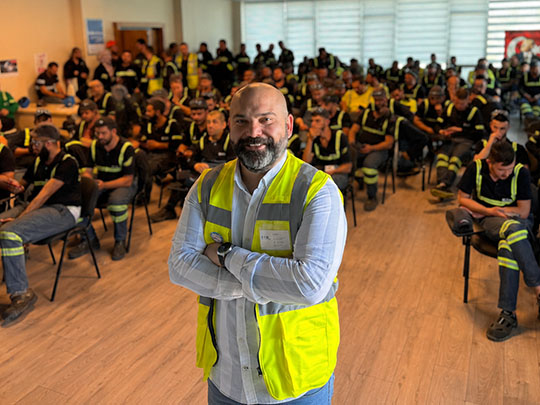
Can you tell us a little about your career background?
I am an environmental, health and safety professional with experience across the manufacturing and energy sectors in Türkiye. Throughout my career, I have focused on developing and improving health, safety and environmental management systems, helping organisations manage risk effectively, strengthen safety culture and achieve continuous improvement.
My experience spans high-risk operational environments, including power generation and manufacturing.
Since October 2025, my focus has been on research, networking and professional development as I prepare for the next stage of my career in consultancy and training. Completing the NEBOSH Level 6 International Diploma for Occupational Health and Safety Management Professionals has been a key part of my preparations
In your last role you were Environmental, Health and Safety Manager for a Power Management Solutions Provider based in Ankara, Türkiye. Can you tell us what that involved?
Most recently I worked as an Environmental, Health and Safety Manager at a facility manufacturing distribution transformers. I was responsible for leading and continuously improving the site’s environmental, health and safety management system. This included ensuring compliance with national legislation and company standards, conducting risk assessments, investigating incidents, managing audits, delivering training and supporting operational teams to identify and control workplace risks before incidents occurred.
A key part of the role involved developing a proactive safety culture by working closely with managers, supervisors and employees to embed health and safety into everyday decision-making rather than treating it as a compliance requirement.
Beyond standard compliance, my focus was on systematic risk mitigation, driving a culture of continuous improvement, and ensuring that EHS principles were woven directly into the operational strategy of the production floor.
I led sustainability initiatives, environmental compliance activities, emergency preparedness programmes, and the management of integrated systems aligned to ISO 9001, ISO 14001 and ISO 45001, whilst analysing performance data to identify opportunities for continuous improvement.
You have also previously worked as an Occupational Health and Safety Assistant Manager for one of Turkey’s major energy companies. Can you tell us about your experiences and what led you to pursue a career in health and safety?
Working as an Occupational Health and Safety Assistant Manager in power generation exposed me to high-risk environments involving mechanical, electrical and process safety hazards. Overseeing complex operations within the energy landscape highlighted a critical truth: robust safety and environmental frameworks are not merely about regulatory compliance; they are the absolute backbone of operational continuity and human wellbeing.
What attracted me to health and safety was the opportunity to make a real difference. Preventing injuries, improving working conditions and helping organisations build stronger safety cultures give me a strong sense of purpose. Over the years, I realised that effective health and safety is not just about enforcing rules, it is about leadership, communication and influencing behaviours.
You have completed your NEBOSH International General Certificate and your NEBOSH Level 6 International Diploma for Occupational Health and Safety Professionals. Why did you take these qualifications, and what made you choose NEBOSH?
I wanted to support my practical experience in the global “gold standard” of health and safety education. NEBOSH provides a universally recognised, rigorous framework that perfectly focuses on applying risk management principles in real workplace situations rather than simply learning legislation.
Since I wanted to build an international career in occupational health and safety, obtaining globally recognised qualifications was an important investment in my professional development.
Did you enjoy the courses?
I thoroughly enjoyed both. While the NEBOSH International General Certificate provided a solid technical foundation, the NEBOSH Level 6 International Diploma for Occupational Health and Safety Professionals challenged me to broaden my perspective.
The courses were challenging, particularly the Diploma, which encouraged me to think critically about risk management and organisational culture rather than simply looking for compliance solutions.
Also, I would like to extend my deepest gratitude to Ege Consulting for their invaluable guidance and support throughout my challenging and rewarding diploma journey.
How did these qualifications benefit you?
The qualifications significantly improved both my technical knowledge and my confidence. They strengthened my understanding of international best practices, safety leadership, human factors and management systems.
More importantly, they changed the way I approach health and safety. Instead of reacting to incidents, I now focus much more on proactive risk management, leading indicators and building a positive safety culture.
Much like my MBA, which expanded my broader business and management acumen, my NEBOSH qualifications bridged the gap between technical safety engineering and executive-level safety leadership.
Can you explain how your role developed or any changes you made/want to make in the business after completing your NEBOSH qualifications?
Completing my NEBOSH Level 6 International Diploma for Occupational Health and Safety Professionals enabled me to pivot from a traditional safety oversight role into holistic safety management. I became much more focused on using data to drive decision-making, strengthening leadership engagement and identifying root causes rather than treating symptoms.
Overall, I have become more confident in influencing senior leaders and integrating health and safety to help businesses ensure that EHS is no longer viewed as a standalone, reactive department, but rather as an embedded, systematic part of their overarching business strategy that actively drives operational excellence.
What do you enjoy most about being a health and safety professional?
The part I enjoy most is making a genuine difference to people’s lives. Every improvement we make has the potential to prevent someone from being injured and ensures they return home safely to their family at the end of the day.
I also enjoy solving complex problems, working with different departments and helping create a culture where people actively care about safety rather than simply following procedures. Seeing employees become engaged and take ownership of safety is one of the most rewarding aspects of the profession.
Looking back on your career to date, what achievements are you most proud of?
One achievement I am particularly proud of is helping organisations strengthen their safety culture through leadership engagement and employee involvement, rather than relying solely on compliance activities.
I am also proud to have progressed from operational safety roles into leadership positions while continuing to invest in my professional development through internationally recognised qualifications such as the NEBOSH Level 6 International Diploma for Occupational Health and Safety Professionals.
Finally, I take pride in earning the trust of operational teams. Building credibility so that people seek safety advice proactively rather than only when required is a significant achievement for me.
What’s next for you in terms of your professional development?
I believe professional development should never stop. After gaining extensive operational experience , my primary focus now is to transition into an international consultancy or collaborate with a global learning partner. I plan to leverage my expertise to support organisations, particularly those involved in renewable energy investments like wind, solar, and green hydrogen, in building robust QHSE frameworks. By focusing on consultancy and training, I aim to help companies engineer safer, more sustainable operations while actively developing the next generation of safety-conscious leaders.
What advice would you give to someone starting a career in health and safety?
My advice would be to focus on developing communication and leadership skills alongside technical knowledge. Understanding legislation and standards is essential, but success in health and safety depends on your ability to influence people, build relationships and gain trust.
Invest heavily in your foundational knowledge early on, seek experience in different industries if possible, and always spend time understanding the realities of the workplace before proposing solutions.
Finally, remember that health and safety is about helping people, not simply enforcing rules. That mindset will help you build both credibility and long-term impact.