
Thinking beyond compliance: A health and safety career journey
Case Study: Maria F. Anderson
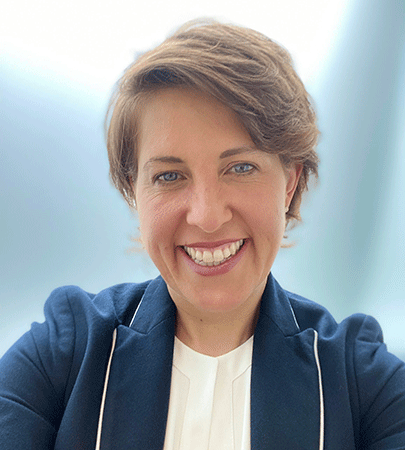
NEBOSH Diplomate Maria F. Anderson is Director of Health, Safety and Wellbeing at the University of East London. In this interview, she shares insights from her career, the qualities she believes are essential for success in the health and safety profession, and her perspective on how the profession is evolving.
Having studied Chemical Engineering to Masters level in Colombia, how did you end up pursuing a career in health and safety in the UK?
I didn’t start out thinking I’d work in health and safety, if I’m honest. I wanted to work in the petrochemical sector. However, my background in chemical engineering meant I had relevant skills and knowledge including a strong understanding of process management, risk, systems, and how things can go wrong, especially in high hazard environments.
When I moved to the UK from Colombia, I had the opportunity to manage a laboratory and a team, as well as support the management systems of a small manufacturing organisation. The role included access to training. I chose a one day health and safety awareness course.
I quickly realised that health and safety was something I wanted to get involved in. The idea of improving processes, combined with the mix of technical thinking and human factors, really suited me, so I decided to strive to build my career in the field.
You completed your first NEBOSH qualification, the National General Certificate in Occupational Health and Safety, in 2004. Why did you choose this qualification and how did it help you?
After the one day awareness course, I wanted to continue learning about health and safety. I researched how to become a health and safety professional, and the NEBOSH General Certificate kept coming up as a recommendation, as it provides a solid foundation and is well recognised in the UK.
This proved to be one of the best decisions I’ve made. It helped me understand the legal framework, the basics of risk assessment, and how organisations are expected to manage health and safety. More importantly, it gave me confidence. I could have proper conversations with managers without feeling like I was guessing.
You went on to complete your NEBOSH National Diploma in 2007. What attracted you to this qualification in particular?
After completing the NEBOSH Certificate, I realised that if I wanted to progress, I needed to go deeper. The Diploma is a big step up. It’s more strategic and far more detailed. What attracted me was that it goes beyond the “what” and into the “why”.
It helped me understand how to design systems, how to interpret legislation properly, and how to think more critically, rather than simply applying rules. By then, I had decided I wanted to become a full time health and safety professional, so the NEBOSH Diploma felt like the best way forward to achieve that goal.
You achieved two other NEBOSH certificates focused on Fire (2010) and Construction (2011). Why did you choose to take these NEBOSH qualifications after completing your Diploma?
By that point, I was working as a consultant across different risk areas. I wanted to be confident that I had a clear understanding of the high risk environments my clients were operating in. Fire and construction both come with very specific risks and legal expectations, so it made sense to take the NEBOSH qualifications that focus on these areas. I also aspired to become a trainer and felt that, if I was going to deliver NEBOSH qualifications, I should complete them myself.
I then moved into an in house health and safety role, and having the qualifications made me more credible when dealing with contractors, estates teams, and projects. They helped me move from offering general advice to making practical, risk based decisions.
What is the best thing you learned through your NEBOSH studies?
Probably learning how to think, not just what to do. I like process and compliance, and NEBOSH teaches you the structure, but the real value is learning how to assess risk properly, challenge assumptions, and apply judgement.
It also helped me understand that good health and safety is not about stopping work, but about enabling it to be done safely.
With your extensive experience gained from over 15 years working in health and safety, what qualities do you believe define a successful H&S professional?
You need to be able to influence – that’s number one. You can know the law inside out, but if you can’t bring people with you, nothing changes. You can’t just tell people they must do something because the law says so.
Organisations are complex, living ecosystems, and you need to become part of them. You need to understand their DNA and how the culture works, because any system you build must align with that DNA. If it doesn’t, it will be rejected.
There are always hundreds of competing priorities, so good judgement is also key – knowing when to push, when to step back, and how to prioritise. Resilience matters too, because you’re often dealing with pressure, incidents, and conflicting demands.
And finally, being practical. The best health and safety professionals don’t just quote regulations; they help people find workable solutions. Our transferable skills are our superpowers – leadership, process management, technology, data, systems, and much more.
You have worked for the University of East London since 2025. Can you tell us about the organisation and its health and safety ethos?
The University of East London is a diverse and fast moving environment. It’s a very ambitious organisation, which makes health and safety both interesting and challenging. We have everything from offices and laboratories to construction projects and a large student population.
What I enjoy most is the real opportunity to shape things. We’re on a journey to mature our approach, moving from reactive and compliance led to something more proactive and structured, aligned with standards such as ISO 45001 and 45003. The support from leadership has been excellent. They want to see improvements and are actively part of the conversation, asking questions and seeking solutions.
There’s also a growing focus on wellbeing, not just physical safety, which is particularly important in a university setting.
As the university's Director of Health, Safety and Wellbeing, what are your key responsibilities?
At a high level, I’m responsible for setting the strategy, making sure we meet our legal obligations, and building a system that actually works in practice.
In practical terms, this means working on governance, risk management, reporting, and ensuring we have the right capability within the team. A big part of the role is influencing senior leaders and helping them understand their responsibilities.
I also focus heavily on providing structure and clarity, making sure roles, processes, and expectations are well defined, so we’re not relying on individuals but on a consistent, sustainable system.
Looking ahead, what are your priorities for the future of health, safety and wellbeing at the University?
For me, it’s about moving from pockets of good practice to something that is consistent across the organisation. We’ve started to build more structure, but the next step is embedding it, so it becomes part of how people work day to day, rather than something separate.
There’s also a strong focus on integrating wellbeing properly into the system, rather than treating it as an add on, and on making better use of data so decisions are based on insight, not just reaction. Strengthening governance so it genuinely supports decision making is another key priority.
It’s still a journey, but the direction is clear.
What do you enjoy most about being a health and safety professional?
For me, it’s about the impact. When health and safety is done well, you can genuinely improve people’s working lives and prevent harm. Working with and collaborating with people is my favourite part of the role.
I also enjoy the variety – no two days are the same. One day you’re working on strategy, the next dealing with an incident, and then collaborating with teams to solve practical problems.
I enjoy the challenge of influencing, especially in complex organisations. I like having conversations about health and safety when someone suddenly says, “Oh, that makes sense.”
For me, our profession really does have it all.
How do you see the role of health and safety evolving in the next few years?
I think the role is already shifting. It’s less about enforcement and more about influence, leadership, and understanding the wider organisational context. There’s also a growing expectation to link health, safety, and wellbeing together, particularly around issues such as stress, burnout, and organisational culture.
As a result, the role is becoming more strategic, while still needing to stay grounded in reality. The challenge is finding the right balance. I feel it’s moving from being primarily operational to being more strategic and people centred.
What would be your advice to anyone at the start of their health and safety career?
Get the basics right – understand process management, the law, risk assessment, how organisations work, and leadership and culture. But don’t stop there.
Spend time with people on the ground and understand the reality of work, not just what policies say. Don’t try to be the “safety police”. Focus instead on building relationships and credibility. If people trust you, they will listen.
Be patient, because it takes time to build experience and confidence, but it’s a really rewarding career if you stick with it.