
Operating safely in a complex urban environment
Case Study: Neil Booth
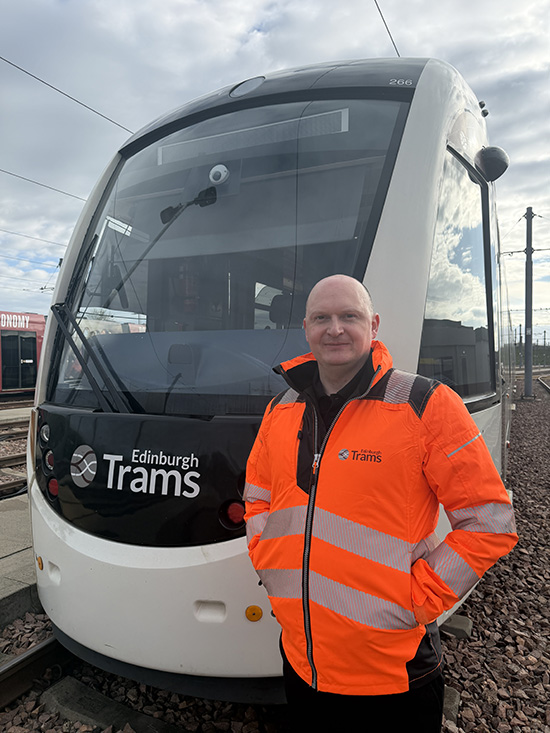
Neil Booth is Safety Manager (Environment) at Edinburgh Trams. In this interview, he talks about the role he plays in helping the organisation deliver a safe, reliable and efficient service, and explains why he chose to sign up for one of NEBOSH’s latest qualifications, the NEBOSH National Certificate in Protecting Enhanced Duty Premises and Events from Terrorism.
When did your health and safety career begin, and what attracted you to the profession?
My career in safety began in 2007 while I was working as a field technician for an international oilfield service company based in Aberdeen. At the time, the company was in the process of gaining ISO certification for its Safety, Quality and Environmental Management Systems, and I was given the opportunity to support this work, specialising in health and safety.
What initially attracted me to the profession was how vital it is, particularly in high-risk industries such as oil and gas. In this sector, health and safety is rightly a core consideration because of the nature of the work involved and the inherent risks. I found that health and safety complemented the technical skills I had already developed, allowing me to contribute to effective operational procedures and risk assessments for staff working out in the field.
By choosing to specialise in safety, I felt I was also building resilience into my career, as it opened opportunities to work across a range of industries. When I later switched sectors, I found that most of the health and safety knowledge and skills I had gained in oil and gas were readily transferable to light rail.
You passed the NEBOSH National General Certificate in 2010 and the NEBOSH Fire Certificate in 2015. Why did you choose these qualifications and how did they support your development?
When I completed the NEBOSH National General Certificate in 2010, it felt like a natural first step towards fulfilling my aspiration to specialise in health and safety. The qualification is globally recognised and highly regarded, as it provides a sound foundation on which to build. I then chose to complete the NEBOSH Fire Certificate to gain more specialist fire safety knowledge as part of my continued professional development.
Clearly you enjoy learning as you have completed numerous qualifications since passing these NEBOSH certificates! Do you have any advice for other safety professionals that will help them balance work and study?
I think it is important to have a plan for what you ultimately want to achieve, while also being adaptable and recognising that your route to that point may change. I have been fortunate in the companies I have worked for, as they have actively supported my development as a safety practitioner, which has been a significant advantage.
You have worked for Edinburgh Trams since 2019. Can you tell us about the company and its health and safety ethos?
Edinburgh Trams is the award-winning operator of the city’s tramway, with a vision to be an integral part of the future success of Edinburgh and the Lothians by providing world-class, environmentally friendly and socially inclusive transport.
We operate a fleet of 27 CAF trams across an 18.4 km network with 23 stops. Services run from Edinburgh Airport through the heart of the city and down Leith Walk, one of the most densely populated areas in the United Kingdom, before reaching the terminus at Newhaven. Our trams pass some of the city’s most popular destinations, including Murrayfield Stadium, Edinburgh Castle, the Scott Monument, St James Quarter and The Royal Yacht Britannia.
At Edinburgh Trams, safety is fundamental to everything we do and is always our foremost consideration. We hold ourselves to the highest possible standards and align our business with the Office of Rail and Road’s Risk Maturity Framework. This ensures we remain committed to delivering a safe, reliable and efficient mode of transport for the city of Edinburgh.
You have been the organisation's Safety Manager (Environment) since July 2021. Please tell us about your role and responsibilities.
As Safety Manager (Environment) at Edinburgh Trams, I work as part of the Safety and Standards department, which provides safety, security and environmental support and advice across the organisation. To ensure the organisation operates a safe and environmentally friendly service, we work closely with colleagues from the Operations, Engineering, Projects and Business Support departments, as well as our core infrastructure and tram maintainers.
Within our team, I lead on areas such as internal audit, environmental management, civil claims handling and work environment safety. However, my role also extends across all aspects of safety within the company.
Neil, you were amongst the first people to complete one of NEBOSH's newest qualifications the NEBOSH National Certificate in Protecting Enhanced Duty Premises and Events from Terrorism, with our Gold Learning Partner, Premier Partnership. Can you tell us the motivation for taking this new qualification?
In light rail, we must comply with specific legislation relating to the management of security across our networks. We also work closely with other transport providers and the city’s emergency services to ensure the safety of passengers and staff on or near the tram network.
This new course appealed to me because it provided the opportunity to develop a deeper understanding of the security requirements that our interfacing organisations across Edinburgh will need to adhere to in the future.
If you would recommend it to others?
Absolutely! I enjoyed the course and feel it is perfect for organisations who want to understand the requirements outlined in the Terrorism (Protection of Premises) Act 2025.
With your extensive experience in health and safety across a range of sectors, what qualities do you believe define a successful H&S professional?
I believe that a successful health and safety professional needs a combination of formally recognised safety qualifications, relevant experience, and a sound working knowledge of their industry to be truly effective. If one of these elements is missing, it can lead to significant gaps in understanding, meaning a challenge or risk may not be identified, or the safety measures put in place to manage it may not be effective.
In addition, successful health and safety professionals require a high degree of integrity and strong influencing skills. These qualities enable us to effectively challenge unsafe behaviours and address safety shortcomings at all levels of an organisation.
It is also important for health and safety professionals to be solutions focused. It is far more effective to offer a practical solution, or to be part of the team developing one, rather than simply highlighting a problem. This approach helps prevent safety from being viewed as a blocker and instead positions us as a partner, encouraging engagement. Ultimately, this supports the continuous improvement of safety culture and organisational maturity.
What would your advice be to others considering a career in health and safety?
If you like learning new things, this is a great career choice, as your education will never stop. In health and safety, there are always new ways of doing things as best practice evolves, along with emerging risks and new legislation to consider. This is why I recently signed up for my latest NEBOSH qualification in counter-terrorism. My first piece of advice, therefore, is to keep learning.
I would also recommend seeking opportunities across a wide variety of industries to broaden your knowledge and experience. Taking this approach gave me a strong foundation and helped me develop into a well rounded safety professional.