
Building a Safer, Greener Embassy: Gitte Dinesen’s Estates Journey in Tunis
Case Study: Gitte Dinesen
Gitte Dinesen is the Estates Manager at the British Embassy in Tunis, where she plays a key role in ensuring the safe, efficient and resilient operation of the diplomatic estate. In this interview, she reflects on her diverse career spanning more than two decades in Tunisia, shares insights from her work in estates and health and safety, and explains how achieving the NEBOSH Health and Safety Management for Construction (UK) qualification has enhanced her impact in the role.

Gitte, although you are originally from Denmark, you have worked in Tunisia for over 20 years. How would you characterise your professional experience?
My professional experience in Tunisia has been defined by long term engagement and continuity within the diplomatic environment. This has required a strong understanding of corporate governance and the ability to build constructive relationships with both host country and international stakeholders. Over time, my work has been shaped by evolving regional and global developments, which has reinforced the need for adaptability, discretion, and consistency in my approach. Within this diplomatic setting, my responsibilities have evolved to include estates management, health and safety, and staff wellbeing. These functions are essential to ensuring that diplomatic missions operate securely, responsibly, and effectively, and they have added a practical and operational dimension to my role.
Since 2010, you have worked as the Estates Manager at the British Embassy in Tunis. Can you tell us about your role?
I lead the Estates function with overall responsibility for facilities management, project delivery, and health and safety compliance, including risk management, mitigation, and incident investigation. My role combines day to day operational oversight - focused on ensuring the safe, efficient running of the estate - with the management of refurbishment and construction projects across the portfolio, in alignment with British standards and regulatory requirements. I also take a strategic lead in developing and implementing the estates and health and safety frameworks that guide our activities. By forecasting future requirements and defining project pipelines, I help ensure the estate continues to meet evolving operational, security, and organisational needs.
In 2024, you completed the NEBOSH Health and Safety Management for Construction (UK) qualification, with NEBOSH Gold Learning Partner, RRC International. Can you share:
Why you chose this qualification?
Having worked in health and safety for over 15 years, I wanted to formalise and strengthen my existing skills, and the NEBOSH qualification was the ideal way to do this. It is internationally recognised, adds significant credibility to my CV, and - being naturally ambitious - I also saw it as an opportunity to challenge myself and continue my professional development
If you enjoyed your studies and found the course content beneficial?
I attended a classroom course and found the interaction with both the facilitator and fellow students extremely fruitful and inspiring. The exam preparation and the assessment itself were hard work, but the extensive online support made the learning process effective and manageable. The course content is very broad and covers all key health and safety topics relevant to the construction industry, providing a comprehensive understanding of essential requirements and best practices.
How have you used the knowledge gained from the NEBOSH Health and Safety Management for Construction (UK) in your work?
After successfully passing the assessment, I developed a health and safety induction pack for external contractors working on our estate. This has provided a practical framework for strengthening our safety culture, enabling us to systematically identify project specific risks and appropriate control measures, while clearly communicating our health and safety expectations and commitment. While cooperation with Tunisian contractors is generally very positive, there can occasionally be differences in how health and safety priorities are approached. This often reflects varying local practices, constraints or levels of awareness rather than a lack of commitment. Rolling out the induction pack has helped raise awareness among local businesses and their employees. Being clear about our expectations and arranging training has further strengthened health and safety standards.
In one sentence, what was the best thing you learned through your NEBOSH studies?
My NEBOSH studies have given me greater confidence to actively contribute to a safer working environment, such as speaking up when I identify unsafe practices or poor safety behaviours.
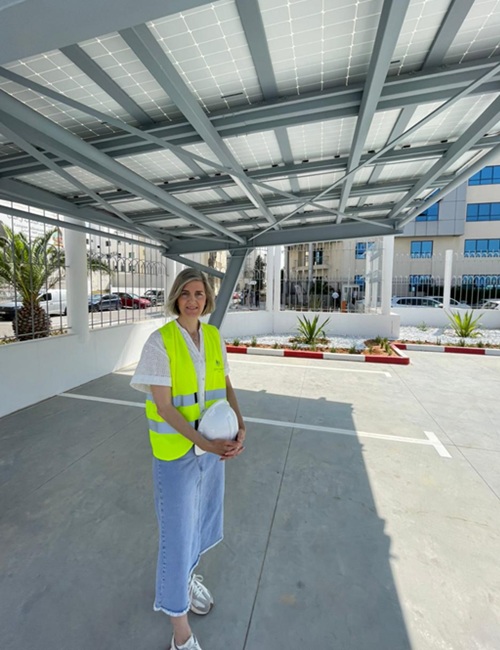 I understand you have worked on a key British Embassy Tunis initiative, designed to help the UK government achieve its Net Zero Goal. Can you tell us about this and share if your NEBOSH qualification helped you in anyway?
I was asked to take on the position of Project Manager for the construction of a solar carport, overseeing the six-month project from conception through to commissioning. The project supports the UK Government’s Net Zero goals. My responsibilities included tracking progress, identifying and mitigating risks, managing contractors, ensuring compliance with local regulations and UK standards, monitoring budgets and timelines, and maintaining clear communication with all stakeholders.
I coordinated multi disciplinary teams carrying out geotechnical surveys, excavation and civil works, erection of steel structures, and, importantly, the installation of electrical circuits, battery storage, and photovoltaic panels. I was also responsible for ensuring that all works were carried out safely and with minimal disruption to embassy operations.
My NEBOSH qualification proved highly valuable throughout the project. It enabled me to apply a structured approach to health and safety management, conduct risk assessments and method statement reviews, and ensure that contractors implemented appropriate control measures. This not only reduced the risk of accidents and delays but also helped embed a strong safety culture on site, supporting the successful and safe delivery of the project in line with its sustainability objectives.
When you look back on your career date, what achievement are you most proud of.
It would have to be the fact that I began my Estates career without a technical background, learning everything on the job and through dedicated training. Continuous learning has kept me focused and motivated and has allowed me to progress and deliver quality outcomes for the organisation.
I believe a good Estates and health and safety professional is defined not only by technical knowledge, but also by personal qualities. Integrity and a strong sense of responsibility ensure that safety and compliance are taken seriously, even under pressure. Good communication and diplomacy are essential for working effectively with a wide range of stakeholders and encouraging positive behaviours without confrontation. Finally, a proactive and observant mindset - combined with empathy and pragmatism - helps anticipate and manage risks in a practical, people focused way.