
Stay up to date
Subscribe to our newsletter
Subscribe to get your monthly news and updates directly from NEBOSH.
Subscribe to get your monthly news and updates directly from NEBOSH.
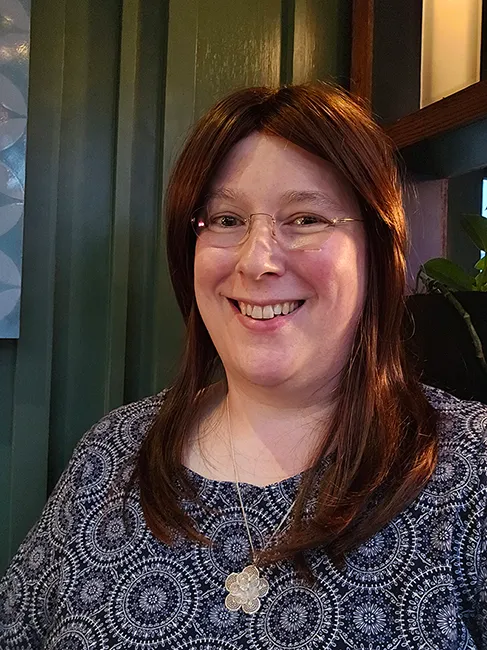
Rosie Russell successfully combines her role as Director of Environment, Health, Safety and Sustainability at MeiraGTx with her positions as Co-President of IIRSM and member of the HS2 Suicide Prevention Committee. In this interview, Rosie shares the key qualities she believes health and safety professionals need to succeed and offers her advice to those aspiring to join the profession.
Rosie Russell
Director of Environment, Health, Safety and Sustainability
MeiraGTx
10 December 2025
|When did you decide you wanted to build your career in health and safety, and how did you make it happen?
I studied Chemistry at university, where chemical safety was always a key consideration. Laboratory risk assessments were an integral part of the coursework, which added to my interest in all things health and safety. Whilst at university, I also met my wife, who was studying for a master’s degree in Risk and Reliability Management, further enhancing the spark of curiosity that was building. Later, while working as a researcher in the lab, I experienced a serious accident when an experiment exploded. I spent four nights in hospital and was off work for a month. This incident changed everything. When I returned to work, I chose to take on responsibility for coordinating health and safety in the lab. In my next role at a small start‑up, I took this responsibility on for the whole company. For the first few years, health and safety was part of my broader role, but I was deeply engaged—reading avidly to build my knowledge until the opportunity to study more formally arose.
You passed the NEBOSH National General Certificate in Occupational Health and Safety, in 2004:
You’re clearly a champion of lifelong learning. Since passing the NEBOSH General Certificate, you’ve gone on to complete three further health and safety qualifications, culminating in a Masters-level achievement. What drives this passion?
Two different things drive my continual development. First, I’m naturally curious and always eager to learn more. Second—and most importantly—my role centres on helping organisations manage risks to their people. Fundamentally, it is a job focused on harm reduction, and I feel this responsibility keenly. As a result, I am always striving to learn and be the best that I can be. A quick look at my bookshelves at home will tell you that learning is a lifelong pursuit for me. But learning doesn’t just come from reading—I also like to learn through experience. When faced with new jobs or unfamiliar environments, I will happily spend days working alongside frontline workers to understand the challenges they face. I’ve even spent time in a milking parlour, hands‑on, milking cows. I may have felt completely out of my depth working with a dairy herd, but that day taught me more than any course or book could.
You generously share your knowledge and time to support others and advance our profession. Can you outline what's involved in the following voluntary roles:
"It doesn't matter if you are driving a forklift truck or working in a laboratory designing a treatment for a genetic condition, the single biggest defence against harm is competence. "
— Rosie Russell, Director of Environment, Health, Safety and Sustainability, MeiraGTx
You manage to fit all of this around your job as the Director of Environment, Health, Safety and Sustainability at MeiraGTx. Could you tell us more about the organisation, its safety ethos, and your responsibilities there?
MeiraGTx is a pharmaceutical company specialising in gene therapies for conditions with no existing treatments. We operate at the cutting edge of medicine and technology. Everything we do, is with the patient in mind, as these treatments, if successful, will be life changing.
Our culture is rooted in “safety first and quality always”. We recognise that nothing will slow us down more effectively than an accident, so we focus heavily on shop floor competence and worker engagement. We have adopted a human factors approach to continuous improvement, with active EHS Councils at each site made up of frontline staff and a management chair. These Councils are empowered to challenge and contribute meaningfully, and their work is overseen by a top-level committee responsible for company-wide strategy and reporting.
In my role, I lead a team of five, responsible for the health, safety and wellbeing of approximately 450 staff across five countries and two continents. Our environments range from research laboratories, pharmaceutical clean rooms to warehousing. We also ensure compliance with environmental standards and drive progress towards our sustainability goals.
Operating in a company that is just eight years old and still in the research phase presents unique challenges. While I contribute at the strategic level, I remain hands-on and operational when needed—whether it’s advising on risk assessments, overseeing maintenance and engineering works, guiding incident investigations, training staff, mentoring managers, writing policies and guidance, conducting inspections, or leading audits. The list goes on.
Much of your health and safety experience has been gained in laboratory environments. What do you consider the key health and safety considerations in this type of workplace?
Competence. The environment may be unfamiliar to many, however safety in the workplace is all about the competence to do the role and understand the risks involved in the daily tasks. This is regardless of the job being undertaken. It really does not matter if you are driving a forklift truck or working in a laboratory designing a treatment for a genetic condition, the single biggest defence against harm is competence. The Health and Safety at Work etc. Act 1974 states that staff must have the information, instruction, training and supervision needed to undertake their role. This fundamentally relates to competence otherwise they may put themselves, and others, at risk.
With your extensive experience in health and safety, what qualities do you believe define a successful H&S professional?
What advice would you give to someone looking to build a career in the health and safety profession?
Rosie Russell successfully combines her role as Director of Environment, Health, Safety and Sustainability at MeiraGTx with her positions as Co-President of IIRSM and member of the HS2 Suicide Prevention Committee. In this interview, Rosie shares the key qualities she believes health and safety professionals need to succeed and offers her advice to those aspiring to join the profession.
Rosie Russell,
Director of Environment, Health, Safety and Sustainability,
MeiraGTx
10 December 2025
|When did you decide you wanted to build your career in health and safety, and how did you make it happen?
I studied Chemistry at university, where chemical safety was always a key consideration. Laboratory risk assessments were an integral part of the coursework, which added to my interest in all things health and safety. Whilst at university, I also met my wife, who was studying for a master’s degree in Risk and Reliability Management, further enhancing the spark of curiosity that was building. Later, while working as a researcher in the lab, I experienced a serious accident when an experiment exploded. I spent four nights in hospital and was off work for a month. This incident changed everything. When I returned to work, I chose to take on responsibility for coordinating health and safety in the lab. In my next role at a small start‑up, I took this responsibility on for the whole company. For the first few years, health and safety was part of my broader role, but I was deeply engaged—reading avidly to build my knowledge until the opportunity to study more formally arose.
You passed the NEBOSH National General Certificate in Occupational Health and Safety, in 2004:
You’re clearly a champion of lifelong learning. Since passing the NEBOSH General Certificate, you’ve gone on to complete three further health and safety qualifications, culminating in a Masters-level achievement. What drives this passion?
Two different things drive my continual development. First, I’m naturally curious and always eager to learn more. Second—and most importantly—my role centres on helping organisations manage risks to their people. Fundamentally, it is a job focused on harm reduction, and I feel this responsibility keenly. As a result, I am always striving to learn and be the best that I can be. A quick look at my bookshelves at home will tell you that learning is a lifelong pursuit for me. But learning doesn’t just come from reading—I also like to learn through experience. When faced with new jobs or unfamiliar environments, I will happily spend days working alongside frontline workers to understand the challenges they face. I’ve even spent time in a milking parlour, hands‑on, milking cows. I may have felt completely out of my depth working with a dairy herd, but that day taught me more than any course or book could.
You generously share your knowledge and time to support others and advance our profession. Can you outline what's involved in the following voluntary roles:
"It doesn't matter if you are driving a forklift truck or working in a laboratory designing a treatment for a genetic condition, the single biggest defence against harm is competence. "
— Rosie Russell, Director of Environment, Health, Safety and Sustainability, MeiraGTx
You manage to fit all of this around your job as the Director of Environment, Health, Safety and Sustainability at MeiraGTx. Could you tell us more about the organisation, its safety ethos, and your responsibilities there?
MeiraGTx is a pharmaceutical company specialising in gene therapies for conditions with no existing treatments. We operate at the cutting edge of medicine and technology. Everything we do, is with the patient in mind, as these treatments, if successful, will be life changing.
Our culture is rooted in “safety first and quality always”. We recognise that nothing will slow us down more effectively than an accident, so we focus heavily on shop floor competence and worker engagement. We have adopted a human factors approach to continuous improvement, with active EHS Councils at each site made up of frontline staff and a management chair. These Councils are empowered to challenge and contribute meaningfully, and their work is overseen by a top-level committee responsible for company-wide strategy and reporting.
In my role, I lead a team of five, responsible for the health, safety and wellbeing of approximately 450 staff across five countries and two continents. Our environments range from research laboratories, pharmaceutical clean rooms to warehousing. We also ensure compliance with environmental standards and drive progress towards our sustainability goals.
Operating in a company that is just eight years old and still in the research phase presents unique challenges. While I contribute at the strategic level, I remain hands-on and operational when needed—whether it’s advising on risk assessments, overseeing maintenance and engineering works, guiding incident investigations, training staff, mentoring managers, writing policies and guidance, conducting inspections, or leading audits. The list goes on.
Much of your health and safety experience has been gained in laboratory environments. What do you consider the key health and safety considerations in this type of workplace?
Competence. The environment may be unfamiliar to many, however safety in the workplace is all about the competence to do the role and understand the risks involved in the daily tasks. This is regardless of the job being undertaken. It really does not matter if you are driving a forklift truck or working in a laboratory designing a treatment for a genetic condition, the single biggest defence against harm is competence. The Health and Safety at Work etc. Act 1974 states that staff must have the information, instruction, training and supervision needed to undertake their role. This fundamentally relates to competence otherwise they may put themselves, and others, at risk.
With your extensive experience in health and safety, what qualities do you believe define a successful H&S professional?
What advice would you give to someone looking to build a career in the health and safety profession?
