
Stay up to date
Subscribe to our newsletter
Subscribe to get your monthly news and updates directly from NEBOSH.
Subscribe to get your monthly news and updates directly from NEBOSH.
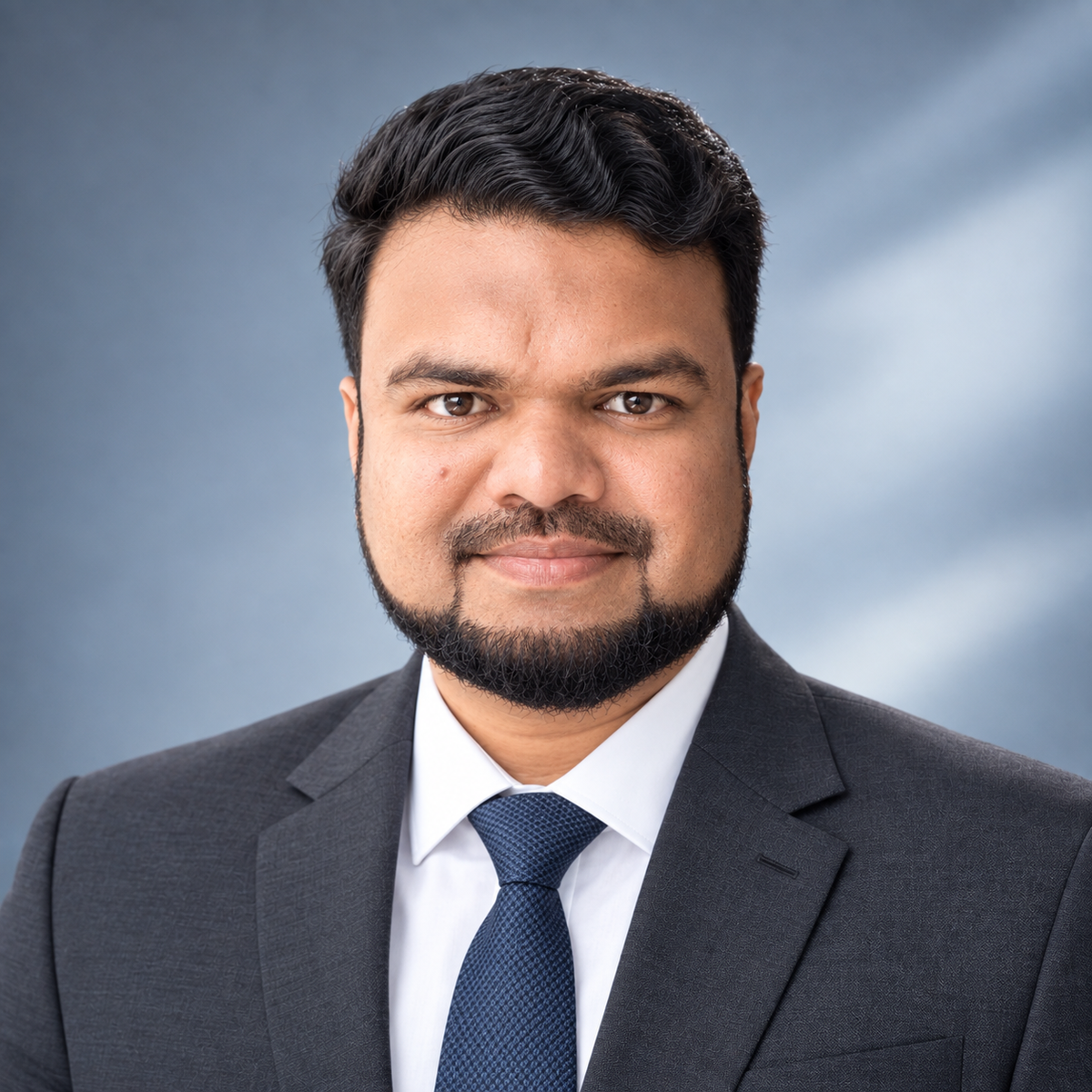
Throughout his career, Mohamed Muzammil has been driven by one goal: helping people return home safely. Now an EHS Manager with Larsen & Toubro Limited in Abu Dhabi, he draws on three NEBOSH qualifications to combine technical expertise with a people-centred approach. Supporting a major renewable energy project, he shares his insights on leadership, adaptability and building a strong safety culture.
Mohamed Muzammil
EHS Manager
Larsen & Toubro Limited
20 November 2026
|You seem to have decided very early on that health and safety was the career for you. What appealed to you about the profession?
The biggest attraction was the opportunity to make a meaningful difference to people's working lives. I have always believed that everyone deserves to return home safely after a day's work, regardless of their position, background or the nature of their job.
As I learnt more about the profession, I realised that health and safety is not simply about enforcing rules or identifying unsafe conditions. It is about understanding people, anticipating what could go wrong and taking action to prevent harm before it happens.
Early in my career, I enjoyed combining my technical knowledge as a mechanical engineer with my interest in human behaviour to positively influence decisions and attitudes towards safety. I quickly learnt that even if you have the best procedures in the world, unless people understand them, believe in them and apply them, their value is limited.
Over time, my interest in health and safety developed into a genuine commitment to the profession. I came to appreciate that our work has an impact far beyond the workplace. When we protect a worker, we are also protecting someone who matters to a family and a community. That sense of responsibility continues to motivate me today.
The first NEBOSH qualification you completed was the Health and Safety at Work Award. Why did you choose it, and how did your studies help you?
I took the NEBOSH Health and Safety at Work Award in 2016 because I wanted to gain an understanding of occupational health and safety rather than relying solely on common sense. At that stage, I was looking for a qualification that covered key safety principles that I could translate into everyday working practices.
It introduced me to essential concepts such as identifying hazards, assessing risks, implementing suitable control measures and recognising the importance of individual responsibilities. Instead of simply observing how a task was being performed, I began to think about the risks involved, what could go wrong and how the task could be carried out more safely.
Looking back, the qualification was an important first step. It gave me the confidence to continue learning and helped build the professional foundation for my career.
You went on to pass the NEBOSH International General Certificate in Occupational Health and Safety. Why did you choose this qualification in particular?
By 2021, I recognised that developing as a health and safety professional required more than practical experience alone. I needed to strengthen my technical understanding and develop a more structured approach to managing workplace risks.
Having previously taken the NEBOSH Health and Safety at Work Award, progressing to the NEBOSH International General Certificate felt like a natural next step. Its international recognition and emphasis on the practical application of occupational health and safety management principles also appealed to me.
I was particularly interested in developing a deeper understanding of risk assessment, management systems, organisational responsibilities and the factors that influence workplace safety performance.
I also wanted to challenge myself academically. I believe professionals should periodically question what they know, revisit their assumptions and remain willing to learn new approaches. For me, pursuing the NEBOSH International General Certificate was not simply about obtaining another qualification. It was about becoming more competent and continuing to develop as a health and safety professional.
How did achieving the NEBOSH International General Certificate in Occupational Health and Safety help you?
It changed how I approached my responsibilities, encouraging me to take a more holistic view of risk and consider how it is influenced by the wider working environment, organisational arrangements and management decisions.
The qualification strengthened my ability to assess risks systematically, evaluate existing controls and recommend practical improvements that operational teams could understand and implement. I also became more confident in explaining not only what needed to change, but why it mattered to engineers, supervisors, managers and workers.
As my career progressed, this became increasingly important. In a busy construction environment, safety professionals need to find solutions that protect people while recognising the realities of project delivery.
The qualification helped me combine technical understanding with practical application. Perhaps most importantly, it reinforced my belief that effective safety management is achieved through cooperation rather than confrontation.
In 2026, you completed the NEBOSH Level 6 International Diploma for Occupational Health and Safety Management Professionals. In one sentence, what has been the best thing you learnt through your NEBOSH studies?
The most important thing I’ve learnt is that lasting safety improvement comes not from controlling people, but from understanding risks, influencing decisions and creating an environment where everyone takes responsibility for protecting one another.
"To me, the strongest safety culture is one where people choose to work safely because they understand its value, not merely because someone is watching"
— Mohamed Muzammil , EHS Manager, Larsen & Toubro Limited
During your career you have moved between countries. Do you have any tips to help others manage change well?
Working across different countries and multicultural environments has been one of the most valuable experiences of my career. The biggest lesson I have learnt is that adapting to change starts with being willing to listen and learn.
Every country has its own regulatory expectations, working practices, communication styles and cultural influences. What works well in one environment may be less effective in another, so it is important to understand these differences rather than assume that previous experience gives you all the answers. Change can be challenging, but stepping away from familiar ways of working can help us develop skills and perspectives we might otherwise never gain.
For safety professionals in particular, communication is essential. You may work with people of many different nationalities, languages, educational backgrounds and levels of experience. Building trust requires patience, respect and the ability to communicate in ways that people can genuinely understand.
My advice would be to remain open-minded, respect the culture of those around you and stay true to your professional values while adapting your approach. Technical knowledge may establish your competence, but humility and adaptability are what help you earn people's trust.
You recently secured a new role with Larsen & Toubro, based in Abu Dhabi. Can you tell us about this?
In September 2026, I joined Larsen & Toubro as an EHS Manager in Abu Dhabi, supporting the Masdar Hybrid Project-2, a major renewable energy development integrating utility-scale solar photovoltaic generation and battery energy storage systems.
Being part of a project of this scale is both an exciting opportunity and a significant responsibility. Large-scale construction brings together multiple contractors and work disciplines, alongside changing site conditions and a workforce with diverse experience and backgrounds.
I oversee the implementation of the project's Environment, Health and Safety Management System, ensuring alignment with applicable UAE regulations, client requirements and recognised international standards. I also lead and support the EHS team across areas including risk management, site inspections, incident prevention, permit-to-work implementation, emergency preparedness, contractor performance and continuous improvement.
A significant part of my role is working closely with construction managers, engineers, supervisors and subcontractors to ensure safety is integrated into the planning and execution of activities. However, I see my responsibility as extending beyond systems, audits and performance indicators.
Developing the capabilities of the safety team is also a priority. I want our officers to take a proactive approach to risk management, understand the activities they are supervising, recognise emerging hazards and engage constructively with the workforce. Our role is not simply to respond once an unsafe condition has been identified.
I am equally focused on strengthening collaboration between the EHS and construction teams. Safety should not be viewed as the responsibility of a separate department, but as an essential part of delivering quality work.
What I find most rewarding is seeing that understanding develop at site level. When workers and supervisors begin identifying risks and taking preventive action without waiting for the safety team, I see that as an important sign of a developing safety culture.
In your opinion, what qualities do you believe a health and safety professional needs to possess to be successful?
I believe a successful health and safety professional needs a combination of technical competence, integrity, empathy, communication skills and the courage to make difficult decisions.
Technical knowledge is essential, but if you cannot translate this knowledge into practical actions that people can understand and follow, your effectiveness diminishes.
Integrity is also important. There will be situations where commercial pressures, deadlines or operational demands create difficult conversations. A safety professional must be prepared to stand by their professional judgement, even when doing so is uncomfortable.
When we identify an unsafe act, our first response should not be to apportion blame. We need to delve deeper to understand why the unsafe act has happened. Factors to consider include the training and instructions workers received, whether the right equipment was available and whether the working environment encouraged shortcuts. This more thorough approach helps us identify the root cause rather than simply correcting what we can see.
I also consider empathy and humility to be essential qualities. No matter how experienced we become, there will always be something to learn from workers, colleagues and the situations we encounter.
Ultimately, I believe the most effective safety professionals are those who are firm in their principles but approachable in practice. People should feel comfortable raising concerns with us, not afraid of being judged for doing so.
How is the role of health and safety evolving based on your experience?
The profession is gradually moving away from a traditional focus on compliance and enforcement towards a more integrated, people-centred and risk-based approach.
In the past, safety performance was solely measured through inspections, compliance records and incident statistics. While these remain important, there is increasing recognition that they do not always provide a complete picture of how safely an organisation is operating. Greater attention is now being given to leadership behaviours, workforce engagement, human factors, organisational culture and the effectiveness of preventive measures.
There is also growing recognition that HSE responsibility and worker wellbeing are interconnected. I have found this to be particularly relevant in the renewable energy sector, where large and complex projects bring together construction, electrical systems, technology, environmental considerations and diverse workforces.
Digital reporting and data analysis are changing how we identify trends and monitor performance, helping us make better-informed decisions by combining them with our sound professional judgement. The increasing use of technology though, does not change the importance of human interaction. A dashboard may tell us that inspections have been completed, but a meaningful conversation with a worker can reveal whether a control measure is genuinely understood and effective.
Health and safety professional now must do so much more than identify non-compliance. We also need to influence organisational decisions, support operational teams and help create working environments where working safely becomes the natural way of doing things.
What do you hope to achieve through your health and safety practice?
I hope to help change the perception that health and safety is something imposed on people by a separate department. I want safety to be understood as a shared responsibility and a natural part of how work is planned, managed and performed.
One of the challenges I have encountered in the construction industry is the tendency to see safety and project delivery as competing priorities. I believe this is a mindset we must work to change. Good safety management should support effective project delivery by encouraging better planning, communication, coordination and decision-making.
As I continue to develop professionally, I want to place particular emphasis on mentoring emerging safety professionals, strengthening practical competence and helping teams become more confident in identifying and managing risks before they lead to incidents.
I also believe we have a responsibility to make safety more accessible to workers from different educational, linguistic and cultural backgrounds. A procedure is only effective when the people expected to follow it can understand and apply it.
Ultimately, I would like my contribution to be reflected not simply in the systems I have implemented, but in the people I have supported and the positive behaviours that continue even when I am not present.
To me, the strongest safety culture is one where people choose to work safely because they understand its value, not merely because someone is watching.
What advice would you give to anyone considering a career in health and safety?
My first piece of advice would be to enter the profession with purpose. Health and safety can offer excellent career opportunities, but it also carries a responsibility that should never be underestimated. The decisions we make, or sometimes fail to make, can have a direct impact on other people's lives.
Build a strong technical foundation through recognised qualifications such as NEBOSH but remember that a certificate is the beginning of your professional development, not the end of it.
Spend time in the workplace. Speak with the people carrying out the activities. Understand the equipment, processes and challenges they deal with every day. Do not be afraid to ask questions and never allow the fear of appearing inexperienced to prevent you from learning.
I would also encourage aspiring professionals to develop their communication and interpersonal skills. You can correctly identify a serious risk, but if you cannot communicate effectively or gain the cooperation of others, achieving improvement becomes much more difficult.
There will be challenging days. Sometimes your advice will be questioned, your decisions may be unpopular, and progress may seem slow. Patience and consistency are essential.
Above all, do not measure your success only by the qualifications you achieve or the position you hold. Measure it by the positive influence you have on the people you work with and the improvements you help to create.
If you remain curious, act with integrity and genuinely care about people, you will have a strong foundation for a meaningful career in health and safety.
Throughout his career, Mohamed Muzammil has been driven by one goal: helping people return home safely. Now an EHS Manager with Larsen & Toubro Limited in Abu Dhabi, he draws on three NEBOSH qualifications to combine technical expertise with a people-centred approach. Supporting a major renewable energy project, he shares his insights on leadership, adaptability and building a strong safety culture.
Mohamed Muzammil ,
EHS Manager,
Larsen & Toubro Limited
20 November 2026
|You seem to have decided very early on that health and safety was the career for you. What appealed to you about the profession?
The biggest attraction was the opportunity to make a meaningful difference to people's working lives. I have always believed that everyone deserves to return home safely after a day's work, regardless of their position, background or the nature of their job.
As I learnt more about the profession, I realised that health and safety is not simply about enforcing rules or identifying unsafe conditions. It is about understanding people, anticipating what could go wrong and taking action to prevent harm before it happens.
Early in my career, I enjoyed combining my technical knowledge as a mechanical engineer with my interest in human behaviour to positively influence decisions and attitudes towards safety. I quickly learnt that even if you have the best procedures in the world, unless people understand them, believe in them and apply them, their value is limited.
Over time, my interest in health and safety developed into a genuine commitment to the profession. I came to appreciate that our work has an impact far beyond the workplace. When we protect a worker, we are also protecting someone who matters to a family and a community. That sense of responsibility continues to motivate me today.
The first NEBOSH qualification you completed was the Health and Safety at Work Award. Why did you choose it, and how did your studies help you?
I took the NEBOSH Health and Safety at Work Award in 2016 because I wanted to gain an understanding of occupational health and safety rather than relying solely on common sense. At that stage, I was looking for a qualification that covered key safety principles that I could translate into everyday working practices.
It introduced me to essential concepts such as identifying hazards, assessing risks, implementing suitable control measures and recognising the importance of individual responsibilities. Instead of simply observing how a task was being performed, I began to think about the risks involved, what could go wrong and how the task could be carried out more safely.
Looking back, the qualification was an important first step. It gave me the confidence to continue learning and helped build the professional foundation for my career.
You went on to pass the NEBOSH International General Certificate in Occupational Health and Safety. Why did you choose this qualification in particular?
By 2021, I recognised that developing as a health and safety professional required more than practical experience alone. I needed to strengthen my technical understanding and develop a more structured approach to managing workplace risks.
Having previously taken the NEBOSH Health and Safety at Work Award, progressing to the NEBOSH International General Certificate felt like a natural next step. Its international recognition and emphasis on the practical application of occupational health and safety management principles also appealed to me.
I was particularly interested in developing a deeper understanding of risk assessment, management systems, organisational responsibilities and the factors that influence workplace safety performance.
I also wanted to challenge myself academically. I believe professionals should periodically question what they know, revisit their assumptions and remain willing to learn new approaches. For me, pursuing the NEBOSH International General Certificate was not simply about obtaining another qualification. It was about becoming more competent and continuing to develop as a health and safety professional.
How did achieving the NEBOSH International General Certificate in Occupational Health and Safety help you?
It changed how I approached my responsibilities, encouraging me to take a more holistic view of risk and consider how it is influenced by the wider working environment, organisational arrangements and management decisions.
The qualification strengthened my ability to assess risks systematically, evaluate existing controls and recommend practical improvements that operational teams could understand and implement. I also became more confident in explaining not only what needed to change, but why it mattered to engineers, supervisors, managers and workers.
As my career progressed, this became increasingly important. In a busy construction environment, safety professionals need to find solutions that protect people while recognising the realities of project delivery.
The qualification helped me combine technical understanding with practical application. Perhaps most importantly, it reinforced my belief that effective safety management is achieved through cooperation rather than confrontation.
In 2026, you completed the NEBOSH Level 6 International Diploma for Occupational Health and Safety Management Professionals. In one sentence, what has been the best thing you learnt through your NEBOSH studies?
The most important thing I’ve learnt is that lasting safety improvement comes not from controlling people, but from understanding risks, influencing decisions and creating an environment where everyone takes responsibility for protecting one another.
"To me, the strongest safety culture is one where people choose to work safely because they understand its value, not merely because someone is watching"
— Mohamed Muzammil , EHS Manager, Larsen & Toubro Limited
During your career you have moved between countries. Do you have any tips to help others manage change well?
Working across different countries and multicultural environments has been one of the most valuable experiences of my career. The biggest lesson I have learnt is that adapting to change starts with being willing to listen and learn.
Every country has its own regulatory expectations, working practices, communication styles and cultural influences. What works well in one environment may be less effective in another, so it is important to understand these differences rather than assume that previous experience gives you all the answers. Change can be challenging, but stepping away from familiar ways of working can help us develop skills and perspectives we might otherwise never gain.
For safety professionals in particular, communication is essential. You may work with people of many different nationalities, languages, educational backgrounds and levels of experience. Building trust requires patience, respect and the ability to communicate in ways that people can genuinely understand.
My advice would be to remain open-minded, respect the culture of those around you and stay true to your professional values while adapting your approach. Technical knowledge may establish your competence, but humility and adaptability are what help you earn people's trust.
You recently secured a new role with Larsen & Toubro, based in Abu Dhabi. Can you tell us about this?
In September 2026, I joined Larsen & Toubro as an EHS Manager in Abu Dhabi, supporting the Masdar Hybrid Project-2, a major renewable energy development integrating utility-scale solar photovoltaic generation and battery energy storage systems.
Being part of a project of this scale is both an exciting opportunity and a significant responsibility. Large-scale construction brings together multiple contractors and work disciplines, alongside changing site conditions and a workforce with diverse experience and backgrounds.
I oversee the implementation of the project's Environment, Health and Safety Management System, ensuring alignment with applicable UAE regulations, client requirements and recognised international standards. I also lead and support the EHS team across areas including risk management, site inspections, incident prevention, permit-to-work implementation, emergency preparedness, contractor performance and continuous improvement.
A significant part of my role is working closely with construction managers, engineers, supervisors and subcontractors to ensure safety is integrated into the planning and execution of activities. However, I see my responsibility as extending beyond systems, audits and performance indicators.
Developing the capabilities of the safety team is also a priority. I want our officers to take a proactive approach to risk management, understand the activities they are supervising, recognise emerging hazards and engage constructively with the workforce. Our role is not simply to respond once an unsafe condition has been identified.
I am equally focused on strengthening collaboration between the EHS and construction teams. Safety should not be viewed as the responsibility of a separate department, but as an essential part of delivering quality work.
What I find most rewarding is seeing that understanding develop at site level. When workers and supervisors begin identifying risks and taking preventive action without waiting for the safety team, I see that as an important sign of a developing safety culture.
In your opinion, what qualities do you believe a health and safety professional needs to possess to be successful?
I believe a successful health and safety professional needs a combination of technical competence, integrity, empathy, communication skills and the courage to make difficult decisions.
Technical knowledge is essential, but if you cannot translate this knowledge into practical actions that people can understand and follow, your effectiveness diminishes.
Integrity is also important. There will be situations where commercial pressures, deadlines or operational demands create difficult conversations. A safety professional must be prepared to stand by their professional judgement, even when doing so is uncomfortable.
When we identify an unsafe act, our first response should not be to apportion blame. We need to delve deeper to understand why the unsafe act has happened. Factors to consider include the training and instructions workers received, whether the right equipment was available and whether the working environment encouraged shortcuts. This more thorough approach helps us identify the root cause rather than simply correcting what we can see.
I also consider empathy and humility to be essential qualities. No matter how experienced we become, there will always be something to learn from workers, colleagues and the situations we encounter.
Ultimately, I believe the most effective safety professionals are those who are firm in their principles but approachable in practice. People should feel comfortable raising concerns with us, not afraid of being judged for doing so.
How is the role of health and safety evolving based on your experience?
The profession is gradually moving away from a traditional focus on compliance and enforcement towards a more integrated, people-centred and risk-based approach.
In the past, safety performance was solely measured through inspections, compliance records and incident statistics. While these remain important, there is increasing recognition that they do not always provide a complete picture of how safely an organisation is operating. Greater attention is now being given to leadership behaviours, workforce engagement, human factors, organisational culture and the effectiveness of preventive measures.
There is also growing recognition that HSE responsibility and worker wellbeing are interconnected. I have found this to be particularly relevant in the renewable energy sector, where large and complex projects bring together construction, electrical systems, technology, environmental considerations and diverse workforces.
Digital reporting and data analysis are changing how we identify trends and monitor performance, helping us make better-informed decisions by combining them with our sound professional judgement. The increasing use of technology though, does not change the importance of human interaction. A dashboard may tell us that inspections have been completed, but a meaningful conversation with a worker can reveal whether a control measure is genuinely understood and effective.
Health and safety professional now must do so much more than identify non-compliance. We also need to influence organisational decisions, support operational teams and help create working environments where working safely becomes the natural way of doing things.
What do you hope to achieve through your health and safety practice?
I hope to help change the perception that health and safety is something imposed on people by a separate department. I want safety to be understood as a shared responsibility and a natural part of how work is planned, managed and performed.
One of the challenges I have encountered in the construction industry is the tendency to see safety and project delivery as competing priorities. I believe this is a mindset we must work to change. Good safety management should support effective project delivery by encouraging better planning, communication, coordination and decision-making.
As I continue to develop professionally, I want to place particular emphasis on mentoring emerging safety professionals, strengthening practical competence and helping teams become more confident in identifying and managing risks before they lead to incidents.
I also believe we have a responsibility to make safety more accessible to workers from different educational, linguistic and cultural backgrounds. A procedure is only effective when the people expected to follow it can understand and apply it.
Ultimately, I would like my contribution to be reflected not simply in the systems I have implemented, but in the people I have supported and the positive behaviours that continue even when I am not present.
To me, the strongest safety culture is one where people choose to work safely because they understand its value, not merely because someone is watching.
What advice would you give to anyone considering a career in health and safety?
My first piece of advice would be to enter the profession with purpose. Health and safety can offer excellent career opportunities, but it also carries a responsibility that should never be underestimated. The decisions we make, or sometimes fail to make, can have a direct impact on other people's lives.
Build a strong technical foundation through recognised qualifications such as NEBOSH but remember that a certificate is the beginning of your professional development, not the end of it.
Spend time in the workplace. Speak with the people carrying out the activities. Understand the equipment, processes and challenges they deal with every day. Do not be afraid to ask questions and never allow the fear of appearing inexperienced to prevent you from learning.
I would also encourage aspiring professionals to develop their communication and interpersonal skills. You can correctly identify a serious risk, but if you cannot communicate effectively or gain the cooperation of others, achieving improvement becomes much more difficult.
There will be challenging days. Sometimes your advice will be questioned, your decisions may be unpopular, and progress may seem slow. Patience and consistency are essential.
Above all, do not measure your success only by the qualifications you achieve or the position you hold. Measure it by the positive influence you have on the people you work with and the improvements you help to create.
If you remain curious, act with integrity and genuinely care about people, you will have a strong foundation for a meaningful career in health and safety.
