
Stay up to date
Subscribe to our newsletter
Subscribe to get your monthly news and updates directly from NEBOSH.
Subscribe to get your monthly news and updates directly from NEBOSH.
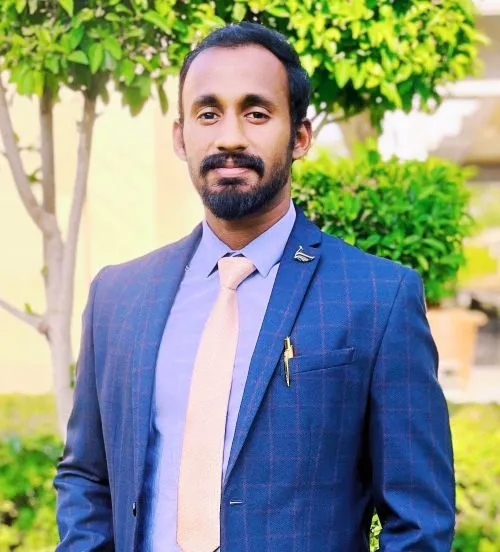
Edwin Thomas is a Manager (HSE) at India’s largest government owned oil producer, Indian Oil Corporation Limited (IOCL). In this interview, he shares some highlights from his career so far and provides advice and guidance to those with similar aspirations
Edwin Thomas
Manager (HSE)
Indian Oil Corporation Limited (IOCL)
12 May 2025
|Have you always known that you wanted to build a career in health and safety? I can see that you studied Safety and Fire Engineering at University.
Not from the very beginning, but what I did know was that I am driven by a desire to make practical, high-impact decisions.
I was among the top performers in the all-India Cochin University of Science and Technology Common Admission Test (CUSAT-CAT). This ranking gave me the privilege of being able to choose from several engineering streams. I did explore Mechanical Engineering and Computer Science, but I eventually opted for a B. Tech in Safety and Fire Engineering. This decision was influenced by both personal responsibility and practical foresight, as I wanted a career that would give me the chance to have a meaningful impact and offered long-term opportunities.
Its multidisciplinary nature also appealed as the course covered engineering design, engineering science, chemical process safety, behavioural science, risk assessments, fire science and legal frameworks. The diverse topics covered gave me confidence that I would gain a holistic understanding and the right tools to contribute meaningfully. This course would not just focus on the technical but applied human and systems perspective as well. That clarity defined the direction of my career.
What appealed to you about the profession in particular?
What drew me most to this profession is its rare balance between technical depth, strategic influence, and human impact. You need to understand mechanical systems, chemical processes, human psychology, environmental science, and risk modelling to ensure safety is built into every layer of an operation. That multidimensional expectation is what makes this profession so intellectually and ethically rewarding.
Over time, I’ve come to realise that a safety professional must be a jack of all engineering disciplines and a Master of Safety. This is not just a metaphor; it’s a lived reality. Whether it’s commissioning fire systems, conducting hazard identification, training teams, or influencing leadership, you're constantly learning, adapting, and leading from the front. In many industrial settings, most departments work in silos, but safety professionals must operate at all levels and influence across the business to be effective. We must make bold, informed decisions to safeguard not just physical assets, but human lives and reputations.
You have worked for Indian Oil Corporation Limited since leaving university. Can you tell us a little bit about the organisation and your work experiences so far?
Indian Oil Corporation Limited (IOCL) is a Maharatna Public Sector Undertaking under the Ministry of Petroleum and Natural Gas. As an integrated energy major, IOCL’s operations span the entire hydrocarbon value chain from refining, pipeline transportation, exploration and production of oil and gas, petrochemicals and alternative energy. It is ranked as the highest Indian energy public sector company on the Fortune 500 list (#116 in 2024) and achieved record revenues of $115 billion in 2022-23. Underscoring its global ambitions IOCLs international footprint now extends to Sri Lanka, Mauritius, the UAE and beyond.
Since joining the company in 2017 I have worked at IOCL’s Viramgam Tank Farm (Gujarat, India) and Chaksu Tank Farm (Rajasthan, India). My career progression has been significant as I first held the role of Officer, then Senior Officer and Assistant Manager before my most recent promotion to Manager (HSE). In my previous roles, I have gained experience in:
These experiences exposed me to large-scale operations, critical decision-making, and helped me to develop my leadership skills in safety management which helped me secure my most recent promotion to Manager (HSE).
Can you tell us about your current role as Manager (HSE) with IOCL?
The Manager (HSE) role is a blend of technical oversight, strategic planning, and people leadership, which is designed to ensure safety is embedded in both operations and culture. Key responsibilities include:
This role allows me to translate technical processes into tangible improvements in safety performance, risk governance, and long-term operational resilience.
You have completed your NEBOSH HSE Certificate in Process Safety Management.
1. Why did you take this qualification and what made you choose NEBOSH?
This course was sponsored by IOCL in collaboration with the Hydrocarbon Skill Sector Council (HSSC) to upskill fire safety engineers across the Pipelines Division. For me, however, it went beyond a formal requirement. I’m committed to continual learning, and NEBOSH provided a structured, international lens on process safety. I was keen to take the qualification because of its:
It reinforced the approach I have always chosen to adopt to risk governance, which is proactive and holistic rather than mere reactive incident management.
2. Did you enjoy the course?
Yes. I already had a strong fire-safety foundation before taking the course but it gave me a much sharper focus on process safety. Many technical concepts were familiar, but the course:
The modules were rigorous yet well-structured, encouraging systemic thinking by linking operational realities to broader risk governance.
"It’s a rare profession where every decision—no matter how small—can save lives, protect families, or prevent environmental catastrophes."
— Edwin Thomas, Manager (HSE), Indian Oil Corporation Limited (IOCL)
3. How did this qualification benefit you?
It added credibility to my profile, but more importantly, it sharpened my conviction in leading safety from a strategic standpoint. While I was already aware of the role that leadership plays in driving safety culture, the qualification helped me navigate process safety with greater clarity and reinforced my ability to embed it into broader operational decisions. It strengthened how I could influence stakeholders more effectively by communicating risk in a structured data-backed way.
It also gave me the momentum to pursue further professional development with purpose.
What’s next for you in terms of your professional development?
I currently hold a TSP certification from BCSP and am a Certified Internal Safety Auditor from OISD (Oil Industry Safety Directorate). Looking ahead, I plan to:
What do you enjoy most about being a health and safety professional?
It’s a rare profession where every decision—no matter how small—can save lives, protect families, or prevent environmental catastrophes. What I enjoy most is the deep sense of purpose it brings. I focus on enabling operational targets to be achieved safely and sustainably, ensuring that for every step forward we consider its impact.
Anticipating potential failures, using predictive analysis to foresee risks, and then implementing preventive measures adds a fascinating dimension to the role.
What achievements in your career are you most proud of?
I am proud to have:
What traits do you think are helpful to possess or develop for those with aspirations to work in health and safety?
What advice would you give to anyone at the start of their health and safety career?
Edwin Thomas is a Manager (HSE) at India’s largest government owned oil producer, Indian Oil Corporation Limited (IOCL). In this interview, he shares some highlights from his career so far and provides advice and guidance to those with similar aspirations
Edwin Thomas,
Manager (HSE),
Indian Oil Corporation Limited (IOCL)
12 May 2025
|Have you always known that you wanted to build a career in health and safety? I can see that you studied Safety and Fire Engineering at University.
Not from the very beginning, but what I did know was that I am driven by a desire to make practical, high-impact decisions.
I was among the top performers in the all-India Cochin University of Science and Technology Common Admission Test (CUSAT-CAT). This ranking gave me the privilege of being able to choose from several engineering streams. I did explore Mechanical Engineering and Computer Science, but I eventually opted for a B. Tech in Safety and Fire Engineering. This decision was influenced by both personal responsibility and practical foresight, as I wanted a career that would give me the chance to have a meaningful impact and offered long-term opportunities.
Its multidisciplinary nature also appealed as the course covered engineering design, engineering science, chemical process safety, behavioural science, risk assessments, fire science and legal frameworks. The diverse topics covered gave me confidence that I would gain a holistic understanding and the right tools to contribute meaningfully. This course would not just focus on the technical but applied human and systems perspective as well. That clarity defined the direction of my career.
What appealed to you about the profession in particular?
What drew me most to this profession is its rare balance between technical depth, strategic influence, and human impact. You need to understand mechanical systems, chemical processes, human psychology, environmental science, and risk modelling to ensure safety is built into every layer of an operation. That multidimensional expectation is what makes this profession so intellectually and ethically rewarding.
Over time, I’ve come to realise that a safety professional must be a jack of all engineering disciplines and a Master of Safety. This is not just a metaphor; it’s a lived reality. Whether it’s commissioning fire systems, conducting hazard identification, training teams, or influencing leadership, you're constantly learning, adapting, and leading from the front. In many industrial settings, most departments work in silos, but safety professionals must operate at all levels and influence across the business to be effective. We must make bold, informed decisions to safeguard not just physical assets, but human lives and reputations.
You have worked for Indian Oil Corporation Limited since leaving university. Can you tell us a little bit about the organisation and your work experiences so far?
Indian Oil Corporation Limited (IOCL) is a Maharatna Public Sector Undertaking under the Ministry of Petroleum and Natural Gas. As an integrated energy major, IOCL’s operations span the entire hydrocarbon value chain from refining, pipeline transportation, exploration and production of oil and gas, petrochemicals and alternative energy. It is ranked as the highest Indian energy public sector company on the Fortune 500 list (#116 in 2024) and achieved record revenues of $115 billion in 2022-23. Underscoring its global ambitions IOCLs international footprint now extends to Sri Lanka, Mauritius, the UAE and beyond.
Since joining the company in 2017 I have worked at IOCL’s Viramgam Tank Farm (Gujarat, India) and Chaksu Tank Farm (Rajasthan, India). My career progression has been significant as I first held the role of Officer, then Senior Officer and Assistant Manager before my most recent promotion to Manager (HSE). In my previous roles, I have gained experience in:
These experiences exposed me to large-scale operations, critical decision-making, and helped me to develop my leadership skills in safety management which helped me secure my most recent promotion to Manager (HSE).
Can you tell us about your current role as Manager (HSE) with IOCL?
The Manager (HSE) role is a blend of technical oversight, strategic planning, and people leadership, which is designed to ensure safety is embedded in both operations and culture. Key responsibilities include:
This role allows me to translate technical processes into tangible improvements in safety performance, risk governance, and long-term operational resilience.
You have completed your NEBOSH HSE Certificate in Process Safety Management.
1. Why did you take this qualification and what made you choose NEBOSH?
This course was sponsored by IOCL in collaboration with the Hydrocarbon Skill Sector Council (HSSC) to upskill fire safety engineers across the Pipelines Division. For me, however, it went beyond a formal requirement. I’m committed to continual learning, and NEBOSH provided a structured, international lens on process safety. I was keen to take the qualification because of its:
It reinforced the approach I have always chosen to adopt to risk governance, which is proactive and holistic rather than mere reactive incident management.
2. Did you enjoy the course?
Yes. I already had a strong fire-safety foundation before taking the course but it gave me a much sharper focus on process safety. Many technical concepts were familiar, but the course:
The modules were rigorous yet well-structured, encouraging systemic thinking by linking operational realities to broader risk governance.
"It’s a rare profession where every decision—no matter how small—can save lives, protect families, or prevent environmental catastrophes."
— Edwin Thomas, Manager (HSE), Indian Oil Corporation Limited (IOCL)
3. How did this qualification benefit you?
It added credibility to my profile, but more importantly, it sharpened my conviction in leading safety from a strategic standpoint. While I was already aware of the role that leadership plays in driving safety culture, the qualification helped me navigate process safety with greater clarity and reinforced my ability to embed it into broader operational decisions. It strengthened how I could influence stakeholders more effectively by communicating risk in a structured data-backed way.
It also gave me the momentum to pursue further professional development with purpose.
What’s next for you in terms of your professional development?
I currently hold a TSP certification from BCSP and am a Certified Internal Safety Auditor from OISD (Oil Industry Safety Directorate). Looking ahead, I plan to:
What do you enjoy most about being a health and safety professional?
It’s a rare profession where every decision—no matter how small—can save lives, protect families, or prevent environmental catastrophes. What I enjoy most is the deep sense of purpose it brings. I focus on enabling operational targets to be achieved safely and sustainably, ensuring that for every step forward we consider its impact.
Anticipating potential failures, using predictive analysis to foresee risks, and then implementing preventive measures adds a fascinating dimension to the role.
What achievements in your career are you most proud of?
I am proud to have:
What traits do you think are helpful to possess or develop for those with aspirations to work in health and safety?
What advice would you give to anyone at the start of their health and safety career?
